
Ctrl K
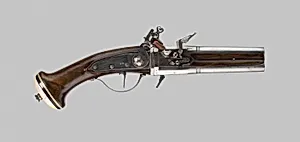
Henri Suber was a French lockmaker and gunsmith active in Marseilles during the 17th century. His early life is not well documented, and no records of his training, teachers, or family have survived. He is known solely through his signature on a single remarkable firearm.
The work that bears his name is a Double-Barrel Revolving Flintlock Pocket Pistol, dated circa 1650–60. Crafted from steel, wood, and ivory, the compact weapon measures just over 11 inches in length and features an ingenious revolving mechanism that allowed the user to fire two barrels in succession. Suber signed the lock, identifying himself as the maker of this critical component. The pistol now resides in the George F. Harding Collection at the Art Institute of Chicago.
This piece belongs to the tradition of high-quality French firearms production in the mid-17th century, a period when Marseilles, as a major Mediterranean port, supported skilled artisans working in metal and wood. Revolving or turn-barrel designs represented advanced engineering for personal defense weapons of the era, combining functionality with decorative elements such as ivory inlay. Suber’s lock demonstrates the precision required to make such mechanisms reliable.
Though little else is known of his career, the survival of this signed pistol in a major museum collection preserves Suber’s contribution to the applied arts of Europe. It stands as a rare documented example of 17th-century Marseilles gunsmithing and continues to illustrate the technical ingenuity of French craftsmen during the Baroque period.