
Double-Barrel Revolving Flintlock Pocket Pistol
c. 1650/60
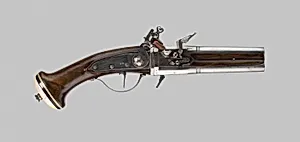
Medium
Steel, wood, and ivory
Dimensions
L. 27.3 cm (10 3/4 in.) Barrel L. 12.7 cm (5 in.) Wt. 1 lb. 2 oz. Caliber .46
Classification
firearm-handgun
Department
Applied Arts of Europe
Museum
Art Institute of Chicago
Accession Number
106486
Rights
Public Domain
Art Historical Context
Crafted by Henri Suber around 1650 to 1660, this Double-Barrel Revolving Flintlock Pocket Pistol is a remarkable artifact of 17th-century European gunsmithing. Compact at 27.3 cm in length with a 12.7 cm barrel and weighing only 1 pound 2 ounces, it was designed as a concealable firearm in .46 caliber, made of steel, wood, and ivory. The flintlock system, in which flint strikes steel to create sparks, marked an important evolution in handheld weapons of this era, offering greater reliability than earlier mechanisms. Its revolving double-barrel feature enabled two shots without reloading, highlighting innovative engineering suited to personal protection. Such pistols were not only practical but also showcased the artisan’s skill in blending form and function through careful material choices. As part of the Art Institute of Chicago’s Applied Arts of Europe collection, this piece invites visitors to appreciate how historical firearms served as both tools and works of art, reflecting the technical and aesthetic standards of their time.
About the Artist
Henri Suber
Henri Suber was a French lockmaker and gunsmith active in Marseilles during the 17th century. His early life is not well documented, and no records of his training, teachers, or family have survived. He is known solely through his signature on a single remarkable firearm. The work that bears his name is a Double-Barrel Revolving Flintlock Pocket Pistol, dated circa 1650–60. Crafted from steel, wo...