Ctrl K
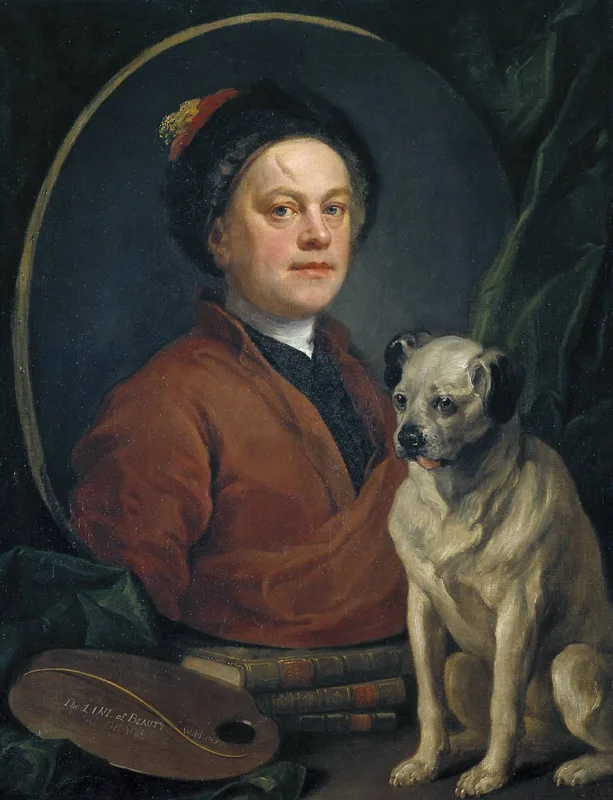
1697–1764
Movements
Occupations
William Hogarth (1697-1764) was an English painter, printmaker, and pictorial satirist who became the first great English-born artist to attract admiration abroad. Born into poverty in London, the son of a failed schoolmaster who was imprisoned for debt, Hogarth's early experiences with the harsh realities of 18th-century urban life profoundly shaped his artistic vision. After apprenticing with silver engraver Ellis Gamble and studying under the renowned history painter Sir James Thornhill—whose daughter he would later marry—Hogarth developed a revolutionary approach to art that combined narrative storytelling with biting social commentary. Hogarth is best known for inventing the "modern moral subject," a series of sequential narrative paintings and prints that functioned like visual novels, depicting the moral consequences of vice and folly in contemporary society. His groundbreaking series—A Harlot's Progress (1732), A Rake's Progress (1735), Marriage A-la-Mode (1745), and others—exposed the corruption, hypocrisy, and cruelty of Georgian England with unprecedented detail and theatrical flair. These works were so popular that they spawned countless pirated copies, prompting Hogarth to lobby Parliament for artist's copyright protection, resulting in the landmark Engravers' Copyright Act of 1735, often called "Hogarth's Act." Beyond his satirical series, Hogarth was a talented portraitist, a pioneering art theorist who published The Analysis of Beauty (1753) expounding his doctrine of the serpentine "Line of Beauty," and a foundational figure in establishing a distinctly British school of painting. Appointed Serjeant Painter to King George III in 1757, Hogarth's influence extended far beyond his lifetime, inspiring generations of visual satirists, political cartoonists, and writers including Charles Dickens. His work laid the groundwork for the modern political cartoon and remains a vital historical record of 18th-century British society in all its complexity.
William Hogarth was born on November 10, 1697, at Bartholomew Close in London, the only son of Richard Hogarth, a minor classical scholar and schoolmaster whose literary ambitions brought scant financial reward. During William's childhood, his father was imprisoned for debt in Fleet Prison, an experience that left an indelible mark on the young artist and would later inform his numerous depictions of prisons and the consequences of financial ruin in works like A Rake's Progress.
At his own request, Hogarth left school in 1713 to apprentice with Ellis Gamble, a silver-plate engraver in Leicester Fields. There he learned to engrave trade cards, shop bills, and similar commercial products. Though this training provided essential technical skills, Hogarth chafed at the drudgery of copying others' designs and aspired to higher artistic achievements. When his apprenticeship expired in 1720 following his father's death in 1718, Hogarth established himself as an independent tradesman-engraver while his younger sisters supported the family by operating a dress shop.
Determined to become more than a commercial engraver, Hogarth enrolled in 1720 at the St. Martin's Lane Academy run by John Vanderbank, a favorite artist of King George I. This marked the decisive step in his training as a painter. When Vanderbank fled to France in 1724 to escape creditors, Hogarth transferred to another drawing school in Covent Garden that had just opened in November 1724, run by Sir James Thornhill, the Serjeant Painter to George I and the foremost history painter in England.
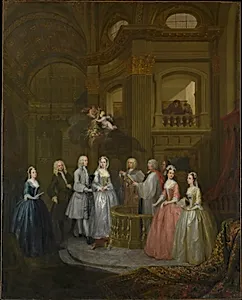
Hogarth's ambition to become a history painter had been fired by seeing Thornhill's late Baroque paintings in progress at St. Paul's Cathedral and Greenwich Hospital. Under Thornhill's tutelage, Hogarth absorbed the principles of grand manner painting while developing his own interests in contemporary subjects. On March 23, 1729, Hogarth eloped with Thornhill's daughter Jane at Paddington Church, a union initially opposed by Sir James who viewed Hogarth as an obscure artist unworthy of his daughter. The marriage proved loving and lifelong, though childless, and eventually reconciliation with Thornhill followed.
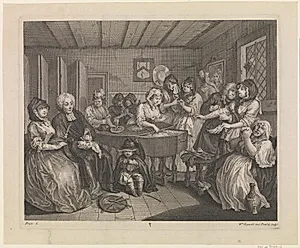
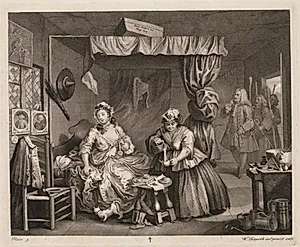
Hogarth's revolutionary career truly began with A Harlot's Progress (1732), a series of six paintings (now destroyed) and engravings depicting the tragic life of Moll Hackabout, an innocent country girl who arrives in London, is tricked into prostitution, imprisoned, and dies of venereal disease. This was the first example of what Hogarth termed 'modern moral subjects'—narrative sequences that told morally instructive stories about contemporary life rather than classical or biblical themes. The series attracted 1,240 subscribers and became a sensation, establishing Hogarth's financial independence and artistic reputation.
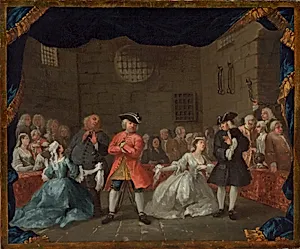
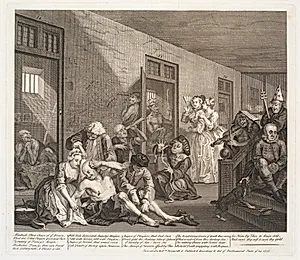
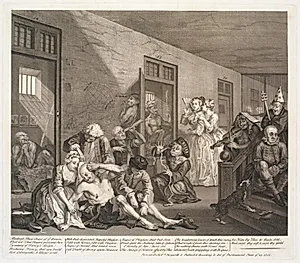
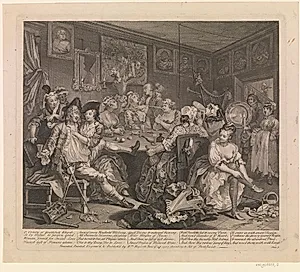
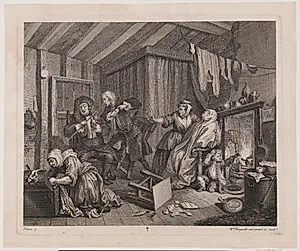
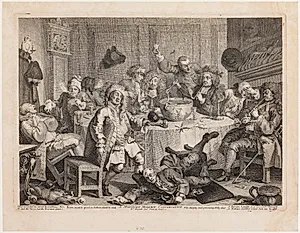
Building on this success, Hogarth created A Rake's Progress (1733-1735), an eight-part series chronicling Tom Rakewell's descent from wealthy heir to debtor's prison and finally to Bethlem Hospital (Bedlam). The paintings, now in Sir John Soane's Museum, and their engravings demonstrated Hogarth's mastery of visual storytelling—what he called his 'comic history-painting.' However, the immediate popularity of these works spawned numerous pirated copies, prompting Hogarth and six fellow engravers to petition Parliament. Their efforts resulted in the Engravers' Copyright Act of 1735 ('Hogarth's Act'), the first copyright law protecting visual works and recognizing individual artists' authorial rights. Hogarth strategically delayed publishing A Rake's Progress until June 25, 1735, the day the Act took effect.
Between 1743 and 1745, Hogarth painted Marriage A-la-Mode, widely regarded as his finest achievement. This six-painting series dissected an aristocratic marriage of convenience, exposing the moral bankruptcy of upper-class society with unprecedented sophistication. Unlike his earlier series, which he had engraved himself, Hogarth employed three French engravers for Marriage A-la-Mode, resulting in prints of exceptional quality. The paintings now hang in the National Gallery, London, testament to their enduring importance in British art.
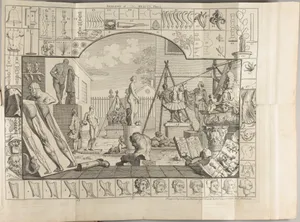
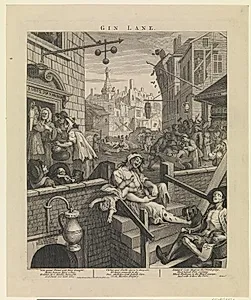
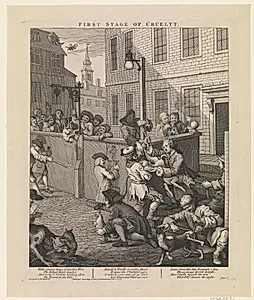
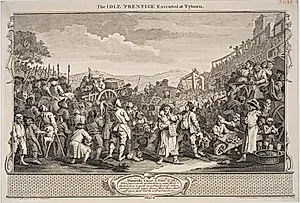
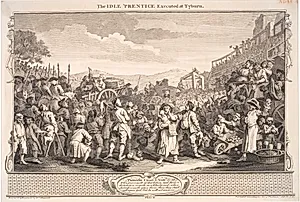
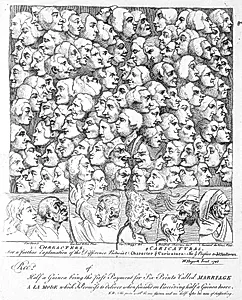
During this period, Hogarth also created powerful social commentary works including Industry and Idleness (1747), which contrasted the fates of two apprentices—one industrious, one idle—and was specifically designed on cheap paper for lower-class audiences. In 1751, he published Beer Street and Gin Lane, paired prints supporting the Gin Act by contrasting the wholesome effects of beer-drinking with the devastation wrought by the gin craze. That same year, he issued The Four Stages of Cruelty, depicting the life of Tom Nero from childhood animal torture to his execution and dissection, designed as moral instruction against cruelty. In 1753, Hogarth published The Analysis of Beauty, his treatise on aesthetic theory centered on the serpentine 'Line of Beauty,' demonstrating his ambition to be recognized not merely as a satirist but as a serious artistic theorist.
In 1757, Hogarth achieved official recognition when appointed Serjeant Painter to King George II, succeeding his late father-in-law James Thornhill in the position—a post he retained when reappointed by George III in 1760. Despite this honor, Hogarth's later years were marked by controversies and disappointments. His attempts at grand history painting earned criticism from Joshua Reynolds and Horace Walpole, who valued the idealizing 'Grand Style' over Hogarth's realistic approach. Reynolds, who would become the first president of the Royal Academy, wrote essays in 1759 implicitly criticizing Hogarth's presumption in attempting historical subjects.
Nevertheless, Hogarth continued working until the end of his life, producing works like the vigorous oil sketch The Shrimp Girl (c. 1740, National Gallery), which became one of his most beloved paintings for its spontaneity and charm. He died on October 26, 1764, reportedly of an aneurysm, and was buried at St. Nicholas's Churchyard in Chiswick. His friend, the celebrated actor David Garrick, composed the inscription for his tombstone. Though he never achieved his ambition to be celebrated as a history painter in the grand manner, Hogarth's legacy proved far more enduring: he founded the English School of painting, pioneered visual satire and narrative art, established copyright protections for artists, and created an incomparable visual record of 18th-century British life.
Artheon Research Team
Last updated: 2025-11-28
Biography length: ~1,247 words
Wikidata/Wikimedia Commons