Ctrl K
Johann Jacob Behr, commonly known as J. J. Behr, was a master gunsmith originally from Würzburg in Bavaria who became renowned for his work in the great firearms centers of Maastricht and Liège. Active from the 1690s until about 1745, he produced exceptional flintlock weapons that combined technical precision with lavish decoration. His early life remains sparsely recorded, with no documented teacher or formal apprenticeship identified in surviving sources, though he established himself as a recognized arquebusier in Liège by the early eighteenth century.
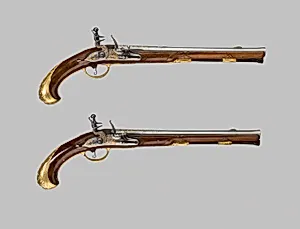
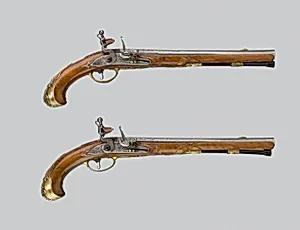
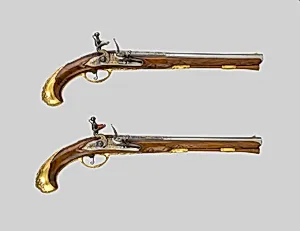
Behr worked firmly within the Liège gunmaking tradition, a school celebrated across Europe for its high-quality, ornately finished arms. His pistols and sporting guns typically feature two-stage barrels with engraved and gilded ornament, French-style locks with goose-neck hammers, brass furniture including openwork side plates and mask-decorated butt caps, and finely sculpted walnut stocks. These pieces exemplify the Baroque taste for blending martial function with sculptural elegance, often incorporating foliage, helmeted heads, and gilt details that elevated firearms to the status of luxury objects.
Among his documented works are a pair of flintlock pistols dated 1700–1730 and a flintlock holster pistol of 1720–1730, both now in the Art Institute of Chicago, as well as a pair of cavalry pistols from around 1730 once in the Gatchina Palace and now in the Victoria and Albert Museum. Additional examples survive in the Rijksmuseum, Amsterdam, and other collections, including sporting guns and a rampart rifle. These surviving pieces, signed “I.I. Behr” or “J. J. Behr,” demonstrate his consistent mastery of both mechanics and surface decoration.
Behr’s legacy endures through these museum-held arms, which illustrate the international prestige of Liège and Maastricht workshops in the early eighteenth century. Though biographical details are limited, his output remains a benchmark for the artistry of European decorative firearms, admired by collectors and historians for its refinement and historical significance.