
Pair of Flintlock Pistols
c. 1725
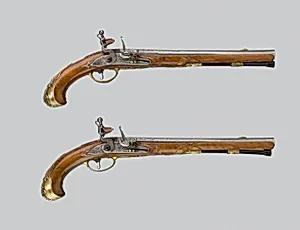
Medium
Walnut, steel, and cast and chased brass
Dimensions
L. 49 cm (19 1/4 in.) Barrel L. 33 cm (13 in.) Caliber .66 Wt. 2 lb. 9 oz. each
Classification
firearm-handgun
Department
Applied Arts of Europe
Museum
Art Institute of Chicago
Accession Number
116549
Rights
Public Domain
Art Historical Context
These elegant Pair of Flintlock Pistols, created by J. J. Behr around 1725, represent the refined craftsmanship of early 18th-century European firearms. Constructed from walnut stocks, steel components, and decorative cast and chased brass, each pistol measures 49 cm long with a 33 cm barrel and weighs just over 2.5 pounds. The .66 caliber design made them practical for personal use while showcasing the gunsmith's skill in blending utility with ornament. Flintlock pistols of this period used a striking flint-and-steel mechanism to ignite gunpowder, a reliable technology that defined firearms across Europe. Matching pairs like this were typically commissioned for gentlemen, officers, or collectors, serving as both defensive tools and symbols of status. Behr's work, now in the Art Institute of Chicago's Applied Arts of Europe collection, highlights how such objects functioned as portable art, with chased brass surfaces featuring hammered decorative motifs that added visual richness to the walnut and steel. The chasing technique allowed artisans to create intricate, raised designs on metal, elevating these weapons beyond mere instruments of the hunt or battlefield. This pair illustrates the cultural role of firearms in 18th-century society, where technical precision met artistic expression in objects meant to impress as much as they protected.
About the Artist
J. J. Behr
Johann Jacob Behr, commonly known as J. J. Behr, was a master gunsmith originally from Würzburg in Bavaria who became renowned for his work in the great firearms centers of Maastricht and Liège. Active from the 1690s until about 1745, he produced exceptional flintlock weapons that combined technical precision with lavish decoration. His early life remains sparsely recorded, with no documented teac...