Ctrl K
1886–1966
Hans Arp, born Hans Peter Wilhelm Arp on September 16, 1886, in Strasbourg—then part of the German Empire but now in France—grew up in a culturally contested border region that mirrored his dual German-French heritage, with a French mother and German father. He began his artistic training at the École des Arts et Métiers in Strasbourg, leaving in 1904, before studying at the Weimarer Kunstschule in Germany from 1905 to 1907—where he encountered his uncle, the landscape painter Carl Arp—and later at the Académie Julian in Paris in 1908. These formative years honed his skills in drawing and painting amid the flux of European modernism, though no single mentor dominated his path; instead, chance encounters shaped him profoundly.
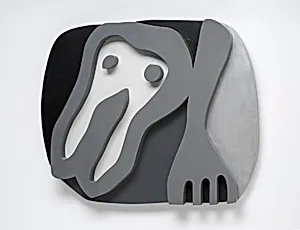
Arp emerged as a pivotal figure in Dada, co-founding the Zurich group in 1916 alongside Hugo Ball, Tristan Tzara, and others, rebelling against war's absurdities through collages and reliefs that embraced randomness, as in *Collage with Squares Arranged According to the Laws of Chance* (1916–17). His style evolved into organic abstraction—biomorphic forms evoking growth, metamorphosis, and nature's fluidity—transitioning from Dada to Surrealism and co-founding Abstraction-Création in 1931. In 1922, he married fellow artist Sophie Taeuber-Arp, whose geometric precision complemented his curvilinear sculptures; their collaboration yielded works like *Shirt Front and Fork* (1922, painted wood). After her tragic death in 1943, he wed longtime companion Marguerite Hagenbach in 1959.
Arp's mature sculptures, often in wood, stone, or bronze, capture undulating, amoeba-like shapes: *Cloud Shepherd* (1953), *Ptolemy* (1953, limestone), *Pagoda Fruit* (1949, bronze), and *Evocation of a Form: Human, Lunar, Spectral* (1950, bronze). His legacy endures through foundations like the Stiftung Arp in Berlin and the Fondation Arp in Clamart, preserving his estate, and accolades including the 1954 Venice Biennale Grand Prize for Sculpture. With ten works in our collection, Arp's embrace of chance and biomorphic poetry bridges Dada's chaos to abstraction's harmony, inviting viewers to ponder form's playful autonomy.
All 2 artworks loaded