
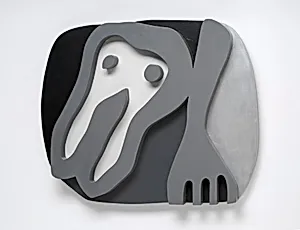
Shirt Front and Fork
1922
Medium
painted wood
Dimensions
overall: 58.4 x 70 x 6.1 cm (23 x 27 9/16 x 2 3/8 in.)
Classification
Sculpture
Department
CMC
Museum
National Gallery of Art, Washington, D.C.
Credit
Ailsa Mellon Bruce Fund
Accession Number
1983.3.1
Rights
Public Domain
Art Historical Context
**Shirt Front and Fork**, created by Jean (Hans) Arp in 1922, is a striking painted wood relief sculpture measuring 58.4 x 70 x 6.1 cm. Acquired through the Ailsa Mellon Bruce Fund for the National Gallery of Art's CMC Department, this work exemplifies Arp's innovative approach to abstraction during a transformative era in modern art. Arp, a founding member of the Dada movement, rejected rigid conventions in favor of organic, biomorphic forms inspired by nature and chance. Working in painted wood—a medium that allowed him to carve and layer shapes with a tactile, sculptural depth—this piece features playful, curvilinear elements evoking the title's everyday objects: a shirt front and fork. Created amid the cultural upheaval following World War I, it embodies Dada's spirit of absurdity and freedom, bridging into early Surrealism by transforming the mundane into dreamlike compositions. Its historical significance lies in Arp's pioneering relief technique, which flattens three-dimensionality into wall-mounted forms, influencing generations of abstract sculptors. Visitors are often delighted by its whimsical title and serene curves, inviting contemplation of how simple materials can evoke the organic poetry of the subconscious. A true gem of 20th-century innovation! (198 words)
About the Artist
Jean (Hans) Arp · 1886–1966
Hans Arp, born Hans Peter Wilhelm Arp on September 16, 1886, in Strasbourg—then part of the German Empire but now in France—grew up in a culturally contested border region that mirrored his dual German-French heritage, with a French mother and German father. He began his artistic training at the École des Arts et Métiers in Strasbourg, leaving in 1904, before studying at the Weimarer Kunstschule i...