
Ctrl K
1594–1694
Johannes (Hans) Mautner, a Hungarian artisan from Brassó (now Brașov, Romania) in Transylvania, remains one of the more obscure figures in Central European decorative arts. Born around 1594 and active through much of the 17th century—though surviving records do not confirm his death in 1694—his life and training are not well documented. Brassó, a prosperous Saxon-influenced trading hub in the Kingdom of Hungary, was a center for skilled metalworkers catering to both burgher and noble patrons amid the region's turbulent Ottoman-Hungarian conflicts. No specific teachers or mentors are recorded for Mautner, nor affiliations with formal guilds or artistic movements, suggesting he operated within the anonymous workshop traditions of Transylvanian goldsmithing.
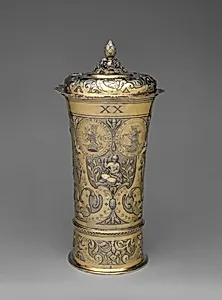
Mautner's known oeuvre reflects the robust, Mannerist-to-Baroque transition in Hungarian silverwork, characterized by intricate repoussé decoration, figural motifs, and functional elegance suited to ecclesiastical or domestic use. His sole surviving attributed work, a *Footed Beaker with Cover* (ca. mid-17th century), held in The Metropolitan Museum of Art (accession 47.104.5), exemplifies this style. Crafted in silver gilt, the beaker features a pear-shaped body adorned with floral engravings, strapwork, and a domed lid topped by a finial, blending Northern European influences with local Transylvanian flair. Such vessels were prized for communal rituals like wine toasting or religious ceremonies, showcasing the artisan's mastery of chasing, gilding, and structural balance.
Though sparsely attested in historical records, Mautner's legacy endures through this meticulously preserved artifact, which highlights the unsung contributions of Brassó's craftsmen to the broader Danube-region decorative arts. In an era when Transylvania bridged Habsburg, Ottoman, and Protestant worlds, pieces like his beaker offer tangible insight into the cultural synthesis of the time, bridging everyday utility with ornamental sophistication. Today, it serves museum visitors as a window into a vanished guild world, underscoring how even lesser-known makers shaped Europe's material heritage. (312 words)