
Footed beaker with cover
Medium
Gilded silver
Dimensions
Overall: 15 3/4 x 6 11/16 in. (40 x 17 cm)
Classification
Metalwork-Silver
Culture
Hungarian, Brassó
Department
European Sculpture and Decorative Arts
Museum
Metropolitan Museum of Art, New York, NY
Credit
Gift of The Salgo Trust for Education, New York, in memory of Nicolas M. Salgo, 2010
Accession Number
2010.110.38a, b
Rights
Public Domain
Tags
Art Historical Context
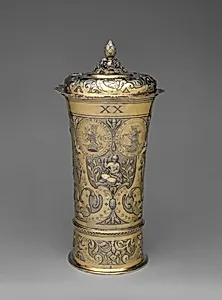
This exquisite footed beaker with cover, crafted in 1682 by Hungarian silversmith Johannes (Hans) Mautner of Brassó (now Brașov, Romania), exemplifies the grandeur of Transylvanian Baroque metalwork. Standing at 15 3/4 inches tall, this gilded silver vessel—likely used for ceremonial toasts—was a symbol of wealth and refinement among the region's Saxon merchant elite. The gilding technique, where a thin layer of gold is applied over silver via mercury amalgamation and firing, created a luxurious sheen that enhanced both durability and visual splendor, making it ideal for display in prosperous households. The beaker's surface features intricate engravings of men playing drums and lutes, evoking lively musical gatherings that reflect the cultural vibrancy of 17th-century Hungary amid Habsburg and Ottoman influences. Such decorative scenes on silverware highlighted the silversmith's mastery of chasing and repoussé, techniques that brought the figures to life with dynamic energy. Brassó's guild traditions ensured high craftsmanship, blending Central European styles with local motifs. Today, this gift from The Salgo Trust to the Metropolitan Museum of Art preserves a slice of Hungarian decorative arts heritage, inviting us to imagine the clink of toasts and strains of lute music from a bygone era.
About the Artist
Johannes (Hans) Mautner · 1594–1694
Johannes (Hans) Mautner, a Hungarian artisan from Brassó (now Brașov, Romania) in Transylvania, remains one of the more obscure figures in Central European decorative arts. Born around 1594 and active through much of the 17th century—though surviving records do not confirm his death in 1694—his life and training are not well documented. Brassó, a prosperous Saxon-influenced trading hub in the King...