Ctrl K
1895–1946
László Moholy-Nagy (1895–1946), born László Weisz in Bácsborsód, Hungary, to a Jewish family, transformed from law student to pioneering modernist after World War I. Orphaned early by his father's departure, he was raised by his mother and guardian uncle Gusztáv Nagy, whose surname inspired his own. After studying law at the University of Budapest, Moholy-Nagy served as an Austro-Hungarian artillery officer, suffering a shrapnel wound in 1917 that ended his military career. He then attended the private art school of Fauve painter Róbert Berény in 1918 and drew mentorship from critic Iván Hevesy and avant-garde leader Lajos Kassák of the MA group. Relocating to Vienna and then Berlin in 1920, he embraced Constructivism, Dada, and Suprematism, experimenting with abstraction, photomontage, and transparency.
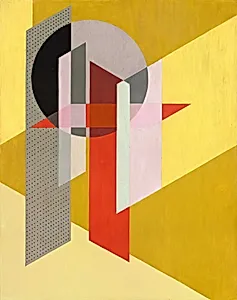
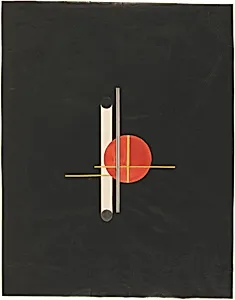
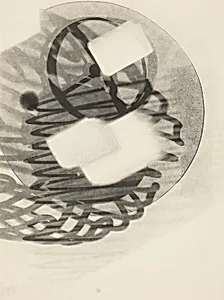
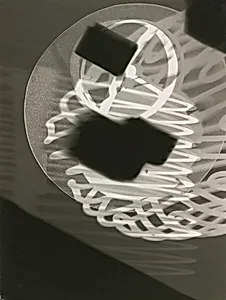
Invited by Walter Gropius, Moholy-Nagy joined the Bauhaus in 1923 as a master, co-teaching the foundational course with Josef Albers and leading the Metal Workshop after Paul Klee. He championed the "New Vision" (Neues Sehen), fusing art, technology, and industry in the Bauhaus tradition, pioneering photograms—cameraless images made by manipulating light and objects on sensitized paper—from 1922 onward, often with first wife Lucia Schulz. Iconic works include *Konstruktion in Emaille 1* (1922–23), a geometric enamel-on-steel "telephone painting" executed remotely via factory instructions; *EM 2 (Telephone Picture)* (1923); and the kinetic *Light Prop for an Electric Stage* (Light-Space Modulator, 1930), a motorized sculpture projecting dynamic light patterns, featured in his film *Ein Lichtspiel: schwarz weiss grau* (1930).
Fleeing Nazis, Moholy-Nagy emigrated through Amsterdam and London before settling in Chicago in 1937 at Gropius's urging. There, naturalized American in 1946, he founded the New Bauhaus (1937–38), reborn as the School of Design (1939) and Institute of Design (1944, now at Illinois Institute of Technology). With second wife Sibylle Pietzsch and daughters Hattula (b. 1933) and Claudia (b. 1936), he produced plexiglass sculptures like *Space Modulator* (1939–45) and *Nuclear I* (1945), alongside color photography and industrial designs.
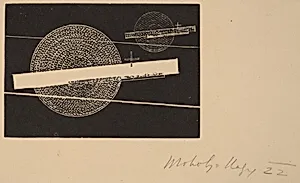
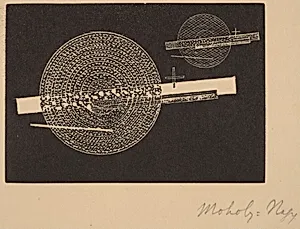
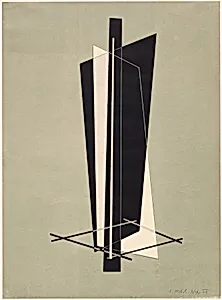
Moholy-Nagy's legacy endures in books like *Painting, Photography, Film* (1925) and *Vision in Motion* (1947), which codified his holistic, process-driven education—"everybody is talented." His Chicago institute exported Bauhaus ideals to America, shaping graphic design, photography, and kinetic art, while his eight works in our collection exemplify his boundless experimentation. He died of leukemia in Chicago on November 24, 1946, his visionary fusion of light, space, and machine still illuminating modern design. (348 words)