
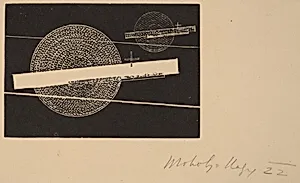
Abstraction II
Medium
linocut
Classification
Department
CG-E
Museum
National Gallery of Art, Washington, D.C.
Credit
Ailsa Mellon Bruce Fund
Accession Number
1971.75.1
Rights
Public Domain
Art Historical Context
László Moholy-N's *Abstraction II (1922) is striking linocut print that captures the artist's pioneering spirit in early 20th-century. Created during Moholy-Nagy's time Berlin amid the vibrant avant-garde scene, this work exemplifies his embrace of geometric abstraction and Constructivist principles. As a Hungarian-born visionary who would soon join the Bauhaus faculty, Moholy-Nagy sought to fuse art, technology, and everyday life, producing bold compositions of interlocking shapes and dynamic lines. Linocut, a relief printing technique using linoleum—a modern, affordable material—allowed Moholy-Nagy to achieve crisp contrasts and vibrant colors with mechanical precision. This medium was revolutionary for printmaking, aligning with the era's fascination with industrialization and mass production. *Abstraction II*, part of a series exploring pure form and space, reflects the post-World War I drive toward universal visual language, free from representational constraints. Housed in the National Gallery of Art through the Ailsa Mellon Bruce Fund, this print highlights Moholy-Nagy's influence on modern design and photography. Visitors will appreciate its timeless energy, a testament to how abstraction can evoke movement and harmony from simple elements.
About the Artist
László Moholy-Nagy · 1895–1946
László Moholy-Nagy (1895–1946), born László Weisz in Bácsborsód, Hungary, to a Jewish family, transformed from law student to pioneering modernist after World War I. Orphaned early by his father's departure, he was raised by his mother and guardian uncle Gusztáv Nagy, whose surname inspired his own. After studying law at the University of Budapest, Moholy-Nagy served as an Austro-Hungarian artille...