
Ctrl K
1813–1901
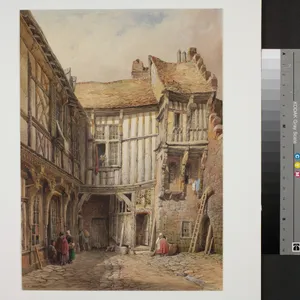
Lewis John Wood (1813–1901) was a British landscape and architectural painter who worked primarily in oil and watercolour, as well as a lithographer. Born in London, he began exhibiting his work as early as 1831 and quickly established himself as a specialist in detailed views of buildings and townscapes. From 1836 onward, he focused much of his attention on scenes from northern France and Belgium, capturing the charm of historic streets, churches, markets, and riverfronts with precision and atmospheric sensitivity.
Wood’s early style was much influenced by the work of Thomas Shotter Boys, whose innovative approach to lithography and watercolour cityscapes left a clear mark on the younger artist’s compositions and technique. He became associated with the New Watercolour Society (N.W.S.), reflecting his commitment to the medium, and produced numerous works on paper that highlight architectural details alongside lively figures. Notable examples include *Kiln in the Wood* (Sunderland Museum & Winter Gardens), *Belfry at Douai* (Ashmolean Museum), and *Views in Limburg* (Victoria and Albert Museum), alongside pieces such as market squares and street scenes from towns like Beauvais and Bruges.
Although little is recorded about formal training or mentors beyond the evident stylistic debt to Boys, Wood’s consistent output and museum presence demonstrate a solid professional career spanning the Victorian era. His watercolours and lithographs remain valued for their topographical accuracy and evocative portrayal of continental European heritage.
Today, Wood’s legacy endures through works held in major British collections, including the V&A, Ashmolean, Fitzwilliam Museum, and Sunderland Museum, where they continue to illustrate the 19th-century fascination with travel, architecture, and the picturesque. His paintings offer modern viewers a window into the historic towns of France and Belgium as they appeared in the mid-to-late 1800s.
All 1 artworks loaded