Ctrl K
1456–1536
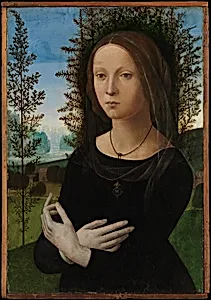
**Lorenzo di Credi (Lorenzo d’Andrea d’Oderigo, c. 1456/59–1537)** was an Italian Renaissance painter and sculptor whose career unfolded almost entirely in Florence. Born to a goldsmith father, he trained in the prestigious workshop of Andrea del Verrocchio, where he is first documented around 1480–81. He quickly rose to become Verrocchio’s principal assistant, running the studio during the master’s absences and inheriting it outright upon Verrocchio’s death in 1488.
While working alongside the young Leonardo da Vinci, Lorenzo absorbed Leonardo’s innovative techniques and sfumato effects, which subtly softened his own precise, Verrocchio-derived style. He remained faithful to the late-fifteenth-century Florentine tradition of meticulously finished religious panels and portraits, avoiding fresco and large-scale commissions in favor of smaller, highly polished works. By the early sixteenth century his approach had grown somewhat old-fashioned, yet he continued to receive important altarpiece commissions well into the 1520s.
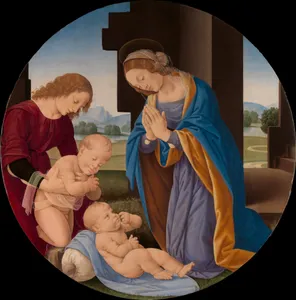
Among his most notable paintings are the *Annunciation* in the Uffizi, the *Adoration of the Shepherds* (c. 1487, also Uffizi), the *Madonna and Child with Saints Julian and Nicholas* (1493, Louvre), and the celebrated *Portrait of Caterina Sforza* (“La dama dei gelsomini”) in Forlì. He completed Verrocchio’s long-delayed *Madonna di Piazza* for Pistoia Cathedral (1485–91) and produced numerous devotional panels, including an *Annunciation* dated 1508 now at Harvard. His workshop trained several younger artists, most prominently Giovanni Antonio Sogliani.
Lorenzo died in Florence in 1537. Although Giorgio Vasari praised his technical refinement, he also noted the artist’s perfectionism and slow working methods. Today Lorenzo is valued both for his own refined devotional images and as a vital link between Verrocchio’s generation and the emerging High Renaissance.