
The Madonna Adoring the Child, with an Angel
early 16th century
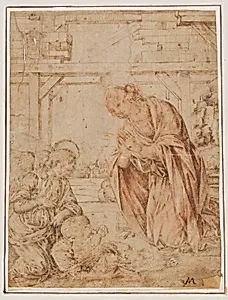
Medium
Pen and brown ink, traces of white, over red chalk underdrawing of the Madonna.
Dimensions
9 1/2 x 7 3/16 in. (24.2 x 18.3 cm)
Classification
Drawings
Department
Robert Lehman Collection
Museum
Metropolitan Museum of Art, New York, NY
Credit
Robert Lehman Collection, 1975
Accession Number
1975.1.371
Rights
Public Domain
Tags
Art Historical Context
Lorenzo di Credi’s “The Madonna Adoring the Child, with an Angel” presents a quiet, devotional scene typical of early 16th-century Italian religious imagery. The drawing captures the Virgin Mary gazing tenderly at the Christ Child, by a single angel, emphasizing themes of maternal love and divine grace that were central to Renaissance piety. Created as a study rather than a finished painting, the work reflects the period’s growing appreciation for drawings as independent expressions of an artist’s skill. Executed in pen and brown ink with traces of white heightening over red chalk underdrawing, the piece reveals di Credi’s careful working method. The red chalk allowed him to establish soft contours and volume before reinforcing the design with precise ink lines, a technique that highlights both spontaneity and control. Such preparatory drawings offer modern viewers an intimate look at how Renaissance artists developed compositions destined for panel paintings or frescoes. Housed in the Metropolitan Museum of Art’s Robert Lehman Collection, this sheet underscores the cultural importance of the Madonna and Child motif in Florentine art. It invites contemplation of the human and sacred intertwined, a hallmark of the era’s artistic and spiritual concerns.
About the Artist
Lorenzo di Credi (Lorenzo d'Andrea d'Oderigo) · 1456–1536
**Lorenzo di Credi (Lorenzo d’Andrea d’Oderigo, c. 1456/59–1537)** was an Italian Renaissance painter and sculptor whose career unfolded almost entirely in Florence. Born to a goldsmith father, he trained in the prestigious workshop of Andrea del Verrocchio, where he is first documented around 1480–81. He quickly rose to become Verrocchio’s principal assistant, running the studio during the master...