
Ctrl K
1782–1867
Louis-Hippolyte Lebas (also spelled LaBas or Le Bas) was a French architect born in Paris on 31 March 1782 and who died there on 12 June 1867. He worked primarily in a rational and severe Neoclassical style, emphasizing clarity, proportion, and restraint over ornamentation.
Lebas trained in the atelier of Charles Percier and Pierre Fontaine, the favored architects of Napoleon. After the emperor’s exile, he remained an assistant to Fontaine and oversaw construction of the sober Chapelle Expiatoire (1816–1824) over the burial site of Louis XVI and Marie Antoinette. He also assisted Éloi Labarre in completing the Palais Brongniart (1813–1826), the Paris stock exchange. Among his independent commissions, the church of Notre-Dame-de-Lorette in Paris (commissioned 1823, completed 1836) stands as one of his best-known works. He also designed the former prison of Petite Roquette (1826–1836, demolished 1974), the first panoptic prison built in France.
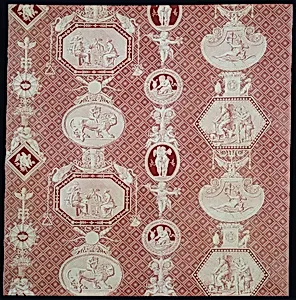
In addition to his architectural practice, Lebas contributed designs for the decorative arts, including the furnishing fabric *La Marchande d’Amour* (The Merchant of Love), a cotton textile engraved-roller printed around 1815–17 by the Oberkampf Manufactory and now in museum collections. From 1840 to 1863 he taught the history of architecture at the École des Beaux-Arts, applying Johann Joachim Winckelmann’s art-historical methods and shaping several generations of French architects. His daughter married the historian and civil servant Léon Halévy.
Lebas’s legacy rests on his disciplined Neoclassical buildings, his pioneering prison design, and his influential teaching, which helped transmit rigorous historical study into nineteenth-century architectural education.
All 1 artworks loaded