
La Marchande d'Amour (The Merchant of Love) (Furnishing Fabric)
1815/17
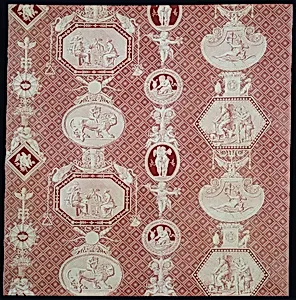
Medium
Cotton, plain weave; engraved roller printed
Dimensions
99 × 95.2 cm (39 × 37 1/2 in.); Warp repeat: H.: 49.8 cm (19 3/4 in.)
Classification
textile
Department
Textiles
Museum
Art Institute of Chicago
Accession Number
25271
Rights
Public Domain
Art Historical Context
This furnishing fabric, titled *La Marchande d’Amour* ( Merchant of Love), was created by Louis Hippolyte LaBas between 181 and 1817.oven in plain-weave cotton and printed using the engraved roller technique, the textile measures roughly 99 by 95 centimeters with a repeating pattern every 50 centimeters. Such mechanically printed cottons marked a significant shift in textile production during the early Industrial Revolution, allowing detailed imagery to be reproduced quickly and affordably for household use. The romantic title suggests a scene drawn from popular visual culture of the period, likely intended to bring a touch of elegance and narrative charm to furniture coverings or curtains. Roller printing, still relatively new at the time, enabled manufacturers to mimic the look of more expensive hand-printed or painted fabrics while meeting growing middle-class demand for decorative goods. Today, this piece in the Art Institute of Chicago’s textile collection offers a vivid glimpse into how art, technology, and domestic life intersected in post-Napoleonic Europe. Its survival highlights the enduring appeal of printed cottons as both functional objects and carriers of visual storytelling.
About the Artist
Louis Hippolyte LaBas · 1782–1867
Louis-Hippolyte Lebas (also spelled LaBas or Le Bas) was a French architect born in Paris on 31 March 1782 and who died there on 12 June 1867. He worked primarily in a rational and severe Neoclassical style, emphasizing clarity, proportion, and restraint over ornamentation. Lebas trained in the atelier of Charles Percier and Pierre Fontaine, the favored architects of Napoleon. After the emperor’s...