Ctrl K
1700–1700
Movements
Occupations
The Master of the Martyrdom of St. Sebastian was an anonymous virtuoso ivory carver active in Vienna during the mid-17th century, embodying the dramatic intensity of the Austrian Baroque. Little is documented about his early life or training, placing him among the shadowy figures of Baroque sculpture whose identities remain elusive despite their technical mastery. He worked in a milieu shared with contemporaries like Matthias Rauchmiller, V. Birke, the Monogrammist B.G., and the Swabian carver C.M. Maucher, suggesting connections within Vienna's elite ivory carving circles.
His style is unmistakable: forceful, exaggerated movements capture extreme emotions, with fanatical attention to anatomical details—elongated muscles, rippling flesh, and wildly carved hair that convey raw physicality and pathos. These traits define his multipart reliefs and fully rounded statuettes, blending religious fervor with mythological vigor in a Baroque tradition that prized theatricality and virtuosic carving.
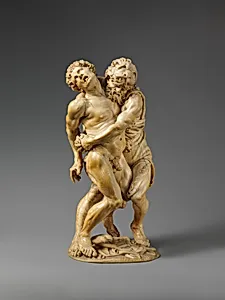
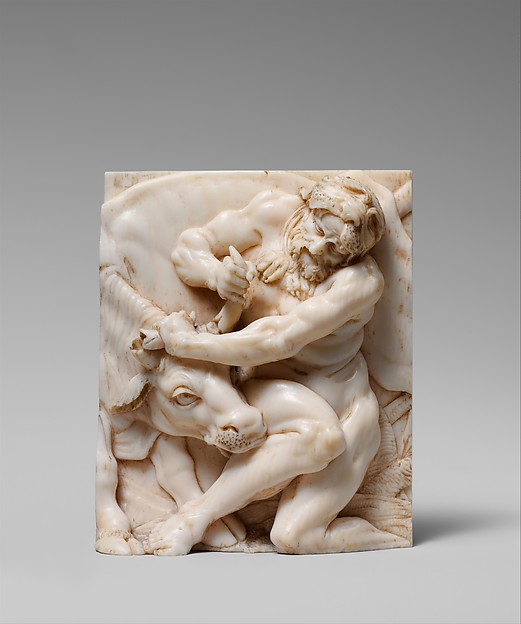
The artist's moniker derives from two monumental ivory reliefs depicting the Martyrdom of St. Sebastian: one dated 1655 (54 x 80 cm) in Vienna's Kunsthistorisches Museum, Stallburg, and another from 1657 (53 x 81 cm) in Linz's Oberösterreichisches Landesmuseum, both showing the saint encircled by tormented victims and Roman archers. Mythological subjects dominate his oeuvre, including the dynamic group Hercules and Achelous (ca. mid-17th century, Metropolitan Museum of Art), where the hero grapples with the shape-shifting river god, and its companion relief of Hercules wrestling Achelous as a bull; other works feature a Captive Hercules (1655), a Standing Male Figure (1657), The Judgement of Solomon, and Man Struggling with a Serpent. Recent scholarship has expanded his catalog with attributions like Christ in the Garden of Gethsemane.
Though sparsely represented in collections today, the Master's intricate ivories endure as pinnacles of Viennese Baroque craftsmanship, influencing later sculptors through their fusion of emotional excess and technical precision. His legacy lies in elevating miniature reliefs to epic scale, preserving the turbulent spirit of 17th-century Habsburg art.
Wikidata (CC0)