
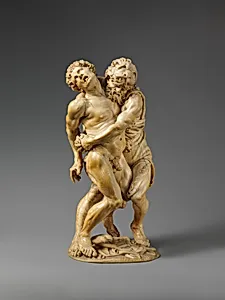
Hercules and Achelous
probably mid-17th century
Medium
Ivory
Dimensions
Overall (confirmed): H. 11 x W. 6 1/4 x D. 4 3/8 in. (27.9 x 15.9 x 11.1 cm)
Classification
Sculpture-Miniature
Culture
probably Austrian
Department
European Sculpture and Decorative Arts
Museum
Metropolitan Museum of Art, New York, NY
Credit
The Jack and Belle Linsky Collection, 1982
Accession Number
1982.60.129
Rights
Public Domain
Tags
Art Historical Context
Behold the intricate *Hercules and Aous*, a masterful ivory miniature sculpted by the enigmatic Master of the Martyr of St. Sebastian, likely in mid-17th-century Austria. This tiny yet dynamic work (just 11 inches tall) captures the climactic clash from Ovid's *Metamorphoses*, where hero Hercules wrestles the shape-shifting river god Aous, who transforms into a bull. artist's anonymous moniker stems from his signature style seen in a painting of St. Sebastian's martyrdom, but here he channels Baroque drama through muscular male nudes locked in fervent combat—echoing the era's fascination with classical mythology and heroic vigor. Carved from a single block of ivory, the sculpture showcases the medium's prized qualities: its creamy translucency allows light to play across contoured forms, while the material's density enabled razor-sharp details in limbs, horns, and rippling tendons. Miniature ivories like this were luxury objects for elite collectors, blending technical virtuosity with sensual realism during the Baroque period, when Northern European workshops rivaled Italy's grandeur. Housed in The Metropolitan Museum of Art's European Sculpture and Decorative Arts department from The Jack and Belle Linsky Collection, this piece invites us to marvel at how a "Master" could infuse such epic scale into pocket-sized splendor, bridging ancient myth with 17th-century artistry.
About the Artist
Master of the Martyrdom of St. Sebastian · 1700–1700
The Master of the Martyrdom of St. Sebastian was an anonymous virtuoso ivory carver active in Vienna during the mid-17th century, embodying the dramatic intensity of the Austrian Baroque. Little is documented about his early life or training, placing him among the shadowy figures of Baroque sculpture whose identities remain elusive despite their technical mastery. He worked in a milieu shared with...