
Ctrl K
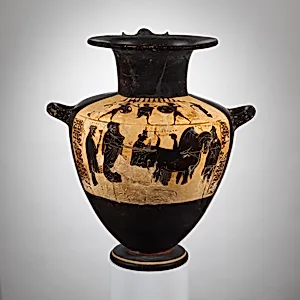
The Mastos Painter was an anonymous Attic vase painter active in Athens during the mid-sixth century BCE, flourishing around 530–520 BCE in the waning years of the black-figure technique. Named by modern scholars after his signature work—a black-figure mastos (a breast-shaped drinking cup) in the Martin von Wagner Museum at Würzburg (inv. 391)—he belonged to the close circle of the Lysippides Painter, a prominent figure who decorated the black-figure sides of bilingual vases alongside the pioneering red-figure Andokides Painter. His style shares affinities with the Antimenes Painter and the mature phases of the Andokides Painter, as well as early red-figure innovators like Oltos and Epiktetos around 515 BCE, marking him as a bridge in the evolution from black- to red-figure pottery.
Working in the robust black-figure tradition, the Mastos Painter favored gently rounded, allusive figures with elastic articulation and a subtle, narrative charm that infused mythological scenes with lively motion and intimacy. He decorated a range of shapes, including mastos cups, neck- and belly-amphorae of the newer Type A, hydriae, and eye-cups. Iconic works include the Würzburg mastos, showing Dionysus amid horse-legged satyrs, Hermes admiring Ariadne cradling the infant Oinopion; a belly-amphora (ca. 525 BCE) depicting Dionysus escorting his mother Semele from the underworld in a satyr-flanked chariot; a genuine Panathenaic prize amphora (530–520 BCE) in the Nafplion Archaeological Museum portraying a victory procession with a nude boy-jockey on a winning horse; a hydria (ca. 530 BCE) at the Metropolitan Museum of Art featuring Herakles and Hebe's bridal chariot amid combat, inscribed in praise of the youth Onetorides; and a terracotta amphora (530–520 BCE) at the Nelson-Atkins Museum of Art with Dionysos holding an ivy branch and wine horn, accompanied by satyrs and Ariadne.
Though sparsely documented personally—typical of ancient workshop artists whose identities survive only through style—the Mastos Painter's contributions highlight the creative vitality of late black-figure Athens, just before red-figure's incised details revolutionized the field. His vases, often exported to Etruria (as with pieces from Vulci), preserve vivid snapshots of Dionysiac revelry, heroic myths, and athletic triumphs, offering invaluable insights into Archaic Greek symposia and festivals. Today, his oeuvre enriches museum collections worldwide, underscoring the technical mastery and storytelling prowess of Attic potters on the cusp of classical innovation.