
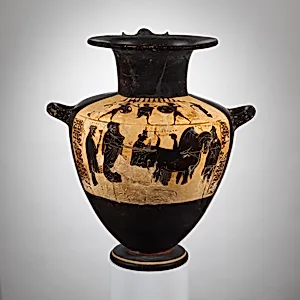
Terracotta hydria (water jar)
ca. 530 BCE
Medium
Terracotta
Dimensions
19 × 16 × 13 1/8 in. (48.3 × 40.6 × 33.3 cm) Diam. of rim: 10 1/2 in. (26.7 cm) Diam. of foot: 6 5/8 in. (16.8 cm)
Classification
Vases
Culture & Period
Greek, Attic · Archaic
Department
Greek and Roman Art
Museum
Metropolitan Museum of Art, New York, NY
Credit
Rogers Fund, 1914
Accession Number
14.105.10
Rights
Public Domain
Tags
Art Historical Context
This elegant terracotta hydria, or water jar, crafted by Mastos Painter around 530 BCE, exemplifies the pinnacle of Attic black-figure pottery during Greece's Archaic period. in Athens, these vessels were both practical for daily use—fetching and storing water via their three handles—and canvases for storytelling. The Mastos Painter, an anonymous master identified by his distinctive style on a signed breast-shaped cup (mastos), favored dynamic mythological scenes, as seen here through tags evoking Herakles, Hermes, Dionysus, horses, chariots, and shields. The black-figure technique, where orange clay figures are outlined in black slip and incised with fine details, highlights the artist's skill in capturing motion and narrative. Likely depicting heroic exploits—perhaps Herakles in a chariot race or divine procession—the decorations reflect Archaic Greek fascination with gods and myths, blending religion, athletics, and heroism. Standing nearly 19 inches tall, its robust form and precise proportions underscore Attic workshops' technical prowess. Acquired by the Metropolitan Museum of Art in 1914 via the Rogers Fund, this hydria offers a window into ancient Athenian life, where pottery was a democratic art form exported across the Mediterranean, spreading Greek culture far and wide. A true treasure for any visitor!
About the Artist
Mastos Painter
The Mastos Painter was an anonymous Attic vase painter active in Athens during the mid-sixth century BCE, flourishing around 530–520 BCE in the waning years of the black-figure technique. Named by modern scholars after his signature work—a black-figure mastos (a breast-shaped drinking cup) in the Martin von Wagner Museum at Würzburg (inv. 391)—he belonged to the close circle of the Lysippides Pain...