Ctrl K

1869–1954
Henri Matisse (1869-1954) was a French painter, draughtsman, printmaker, and sculptor who is widely regarded as one of the most influential artists of the 20th century and the greatest colorist of his era. Born in Le Cateau-Cambresis in northern France, Matisse initially studied law before discovering his passion for art during a period of convalescence at age 20. He became the leading figure of Fauvism, the first major avant-garde movement of the 20th century, which revolutionized the use of color in painting by divorcing it from literal description and emphasizing its expressive and structural potential. Matisse's artistic journey spanned nearly six decades, during which he continuously evolved his style while maintaining his commitment to vibrant color and simplified forms. From the explosive colors of his Fauvist period through his luminous Nice paintings of odalisques, to his late paper cut-outs, Matisse consistently sought to create art that would be 'a soothing, calming influence on the mind, something like a good armchair.' His rivalry and friendship with Pablo Picasso came to define two divergent paths of modern art, with Matisse representing color and decoration against Picasso's form and deconstruction. Matisse's influence on subsequent generations of artists has been profound, particularly on Abstract Expressionists and Color Field painters including Mark Rothko, Kenneth Noland, and Richard Diebenkorn. His paper cut-outs, created in his final years when confined to a wheelchair, synthesized his lifetime exploration of drawing, color, and form into works of extraordinary vitality and directness.
Born on December 31, 1869, in Le Cateau-Cambresis, Picardy, France, Henri Matisse was the son of a prosperous grain merchant who expected his son to follow a conventional career path. Matisse dutifully studied law in Paris, passing his bar examination with distinction and taking a position as a law clerk in Saint-Quentin.
A transformative moment came in 1890 when Matisse, recovering from appendicitis at age 20, was given a box of paints by his mother to help pass the time. He later described this discovery as finding 'a kind of paradise.' Despite his father's deep disappointment, Matisse abandoned his legal career to pursue art.
In 1891, Matisse moved to Paris to study at the Academie Julian under William-Adolphe Bouguereau, though he found the academic approach stifling. His crucial artistic formation came under Gustave Moreau at the Ecole des Beaux-Arts from 1892 to 1898. Moreau's Symbolist approach and his dictum that 'colors must be thought, dreamed, imagined' profoundly shaped Matisse's artistic philosophy.
Matisse married Amelie Parayre in 1898, and together they would raise three children through years of financial struggle. During this period, he began collecting avant-garde art, including a small painting by Cezanne that would prove deeply influential on his development.
The years around 1900 saw Matisse experimenting intensively with Post-Impressionist styles, studying the works of Van Gogh, Gauguin, and Cezanne, as well as the Neo-Impressionism of Seurat and Signac. His painting 'Luxe, Calme et Volupte' (1904-05) represented his only major Neo-Impressionist work, using Pointillist technique with outlined figures.
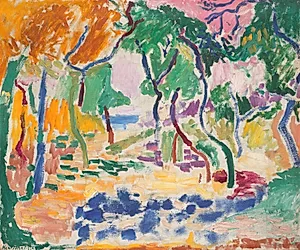
The summer of 1905 in Collioure with Andre Derain marked a decisive breakthrough. Working in the brilliant Mediterranean light, the two artists developed a new style using pure, unmodulated colors and bold brushwork that rejected traditional modeling and perspective. When their works were exhibited at the Salon d'Automne in 1905, critic Louis Vauxcelles described the room as 'Donatello among the wild beasts (fauves),' giving the movement its name.
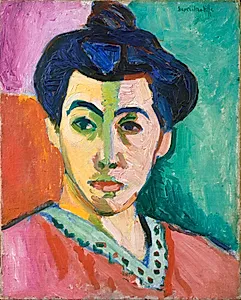
Matisse's 'Woman with a Hat' (1905), a portrait of his wife in explosive, non-naturalistic colors, caused a scandal at the Salon but was purchased by the American collectors Gertrude and Leo Stein, beginning an important patronage relationship. His monumental 'Joy of Life' (1905-06) further developed Fauvism's principles with broad, flat areas of color in an arcadian scene.
Though Fauvism as a movement lasted only until about 1908, it established Matisse's reputation as a leader of the avant-garde. In 1908 he opened an art school that attracted about 80 students over three years. He also gained the crucial patronage of Russian collector Sergei Shchukin, who commissioned major decorative works including 'Dance' and 'Music' (1909-10).
Following the Fauvist period, Matisse continued to evolve his style while absorbing influences from Cubism and other movements. Travels to Morocco (1912-13) intensified his interest in Islamic art and decorative patterns. Works like 'The Moroccans' (1915-16) showed Cubist influence in their geometric simplification and use of black to organize the composition.
'Bathers by a River' (1917), worked on over eight years, represented Matisse's most sustained confrontation with Cubism, featuring monumental figures in a radically simplified pictorial space.
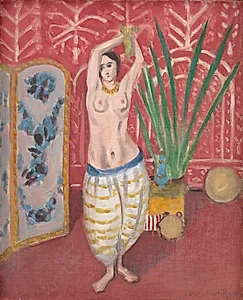
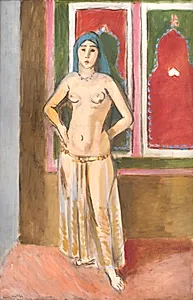
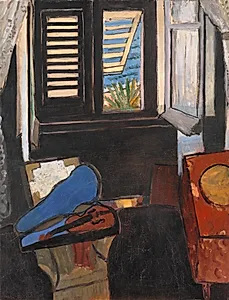
In 1917 Matisse moved to Nice, beginning what is known as his Nice period. His principal subjects became the female figure and the odalisque, women dressed in oriental costumes or in various states of undress, depicted in luxurious interiors of his own creation. These paintings are characterized by southern Mediterranean light, bright colors, and profuse decorative patterns.
The Nice period paintings, though commercially successful, were sometimes criticized as decorative retreats from modernism. By 1930, Matisse himself experienced an artistic crisis, traveling to Tahiti and America in search of new directions.
The 1930s brought renewed vigor and bolder simplification to Matisse's work. American collector Albert C. Barnes commissioned him to create a large mural for the Barnes Foundation in Merion, Pennsylvania. After an initial version proved wrongly sized, Matisse completed 'The Dance II' in 1932, a dynamic composition of leaping figures that marked a return to the ambition of his earlier decorative projects.
During this period, Matisse increasingly simplified his forms while maintaining his commitment to expressive color. He worked on major paintings and continued his exploration of drawing and printmaking.
The outbreak of World War II brought personal and professional challenges. Though Matisse could have emigrated to safety, he chose to remain in France, continuing to work throughout the occupation.
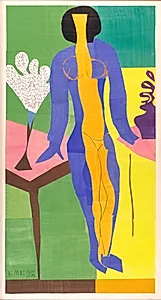
In 1941, major surgery for cancer left Matisse largely confined to a wheelchair for the remaining years of his life. Rather than diminishing his output, this physical limitation catalyzed one of his most innovative late periods. Unable to paint at an easel for extended periods, Matisse developed his paper cut-out technique, which he called 'painting with scissors.'
The cut-outs, made by cutting shapes from sheets painted with gouache and arranging them into compositions, allowed Matisse to work directly with color and form in a way that synthesized his lifetime exploration of drawing and painting. He described the technique as distilling objects to their 'essential character' until they became symbols.
The publication of 'Jazz' in 1947 showcased this technique in a book combining brilliant cut-out illustrations with his written reflections on art and life. Works like 'Blue Nude II' (1952) demonstrated how the cut-outs could achieve both monumentality and intimacy.
Matisse's most ambitious late project was the Chapelle du Rosaire in Vence, completed in 1951 after three years of work. What began as a commission for stained glass windows expanded to encompass the entire interior and exterior design, including vestments and liturgical objects. Matisse considered it his masterpiece, a synthesis of all his artistic concerns.
Henri Matisse died of a heart attack on November 3, 1954, in Nice. He left behind a body of work that fundamentally altered the course of modern art and continues to influence artists today.
claude-biography-agent
Last updated: 2025-11-30
Biography length: ~1,850 words