
Ctrl K
1782–1837
Matthew Egerton Jr. (ca. 1765–1837) was a leading American cabinetmaker and joiner based in New Brunswick, New Jersey. He studied under his father, Matthew Egerton Sr. (c. 1739–1802), who had established the family workshop after arriving in the growing river port in the 1760s. Jr. likely began working independently in the 1780s and assumed full control of the shop on Burnet Street upon his father’s death in 1802. He married Maria Bergan, a woman of Dutch ancestry, and two of their sons—John Bergan (born 1791) and Evert (born 1795)—followed him into the cabinetmaking trade, extending the family enterprise across three generations until 1838.
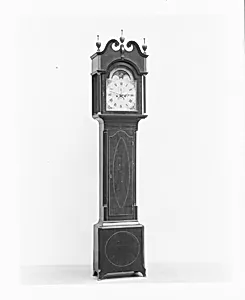
Egerton worked firmly in the Federal-period tradition of New Jersey furniture, blending fashionable neoclassical inlay and figured mahogany veneers with regional forms and lingering ethnic preferences. His pieces often feature distinctive details such as swan-neck pediments on tall clocks, pencil inlay, fluted columns, and chamfered corners. Because so many of his works survive with original printed paper labels identifying him as “Matthew Egerton, Junior, Joiner and Cabinetmaker” of New Brunswick, they constitute the largest body of documentary evidence for the shop and have become essential to decorative-arts scholarship. Clients included both local patrons and those of Dutch descent who commissioned traditional kasten (large wardrobes).
Among his documented works are a mahogany tall clock of 1810–15, now in the Metropolitan Museum of Art, whose case displays the characteristic New Jersey arched pediment, elliptical stringing, and gilded finials; labeled kasten made around 1800; Federal inlaid sideboards, desks, and Pembroke tables; and Chippendale-style linen presses and cherry tall-case clocks. These objects illustrate both the expansion of consumer taste in the early republic and the persistence of older forms. In June 1835 a rare tornado struck New Brunswick, inflicting heavy damage on Egerton’s warehouse and home.
Egerton’s extensively labeled furniture, sought by collectors since the late 1920s, remains a cornerstone for understanding mid-Atlantic cabinetmaking. Examples reside in major museums and continue to appear at auction, underscoring the Egerton workshop’s lasting importance to American decorative arts. His career embodies the skilled, family-based craft tradition that furnished prosperous households along the Raritan River during a period of rapid stylistic and economic change.