
Tall Clock
1810–15
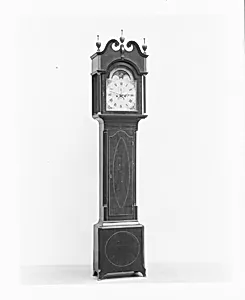
Medium
Mahogany, satinwood, tulip poplar, white pine
Dimensions
90 x 19 x 10 1/4 in. (228.6 x 48.3 x 26 cm)
Classification
Tall clock
Culture
American
Department
The American Wing
Museum
Metropolitan Museum of Art, New York, NY
Credit
The Sylmaris Collection, Gift of George Coe Graves, 1930
Accession Number
30.120.62
Rights
Public Domain
Art Historical Context
This elegant tall clock, crafted by American cabinetmaker Matthew Egerton Jr. between 1810 and 1815, exemplifies the refined furniture traditions of the early republic. Standing over seven and a half feet tall, the piece combines rich mahogany with contrasting satinwood accents, while tulip poplar and white pine form the secondary structure. These material choices reflect both the availability of native woods and the desire for visual warmth and sophistication in American homes of the period. As a functional timepiece and status symbol, such clocks played a central role in domestic life, marking hours in parlors and hallways while showcasing the owner’s taste and prosperity. Egerton’s work captures the transition from Federal restraint to the bolder forms emerging in the early nineteenth century, with its slender proportions and careful attention to grain and finish highlighting the cabinetmaker’s skill. Housed in the Metropolitan Museum’s American Wing, this clock offers visitors a tangible connection to the craftsmanship and daily rhythms of the young nation, reminding us how everyday objects once embodied both utility and quiet beauty.
About the Artist
Matthew Egerton Jr. · 1782–1837
Matthew Egerton Jr. (ca. 1765–1837) was a leading American cabinetmaker and joiner based in New Brunswick, New Jersey. He studied under his father, Matthew Egerton Sr. (c. 1739–1802), who had established the family workshop after arriving in the growing river port in the 1760s. Jr. likely began working independently in the 1780s and assumed full control of the shop on Burnet Street upon his father...