
Ctrl K
1601–1612
Michael Czikos de Tarcal was a Hungarian silversmith active in Kassa (present-day Košice, Slovakia) from 1601 to 1612, a period when the city thrived as a center for metalworking in the Kingdom of Hungary. Little is known of his early life or training, as records from this era are sparse for craftspeople of his standing, though Kassa's guild system likely shaped his apprenticeship in the local goldsmith tradition. His brief documented career produced exquisite objects that bridged Renaissance opulence and emerging Baroque influences, showcasing technical prowess in silver chasing and exotic material integration.
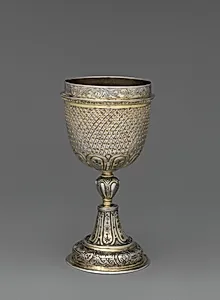
Czikos de Tarcal's most celebrated surviving work is a standing cup, one half of a double cup set, crafted in silver during the early 17th century. Measuring 5 3/4 x 2 3/4 x 2 3/4 inches, its surface features punched intersecting lines forming a netlike lattice, mimicking the air-bubbled diamond patterns of Renaissance reticello glassware—a clever adaptation of Venetian techniques into metalwork, with light-catching dots enhancing the sparkle. The tall lip allowed it to pair with its mate inverted atop like a grand lid; a matching example resides in the Metropolitan Museum of Art alongside this piece (acquired 2010). He also collaborated with fellow Kassa goldsmith Szegedi Tamás on silver-mounted coconut goblets (kókuszdióserlegek), transforming tropical shells into luxurious drinking vessels around the late 16th to early 17th century, exemplifying the era's fascination with global imports.
Working in the robust Kassa silversmith school tradition, Czikos de Tarcal exemplified the fusion of local craftsmanship with international motifs, drawing from Italian glassmaking and Northern European punchwork. His pieces, now museum treasures, highlight the sophistication of Hungarian metalwork amid the turbulent early 1600s, marked by Ottoman pressures and Habsburg rule. Though sparsely documented, his legacy endures through these rare artifacts, offering a glimpse into the artistry of a vanished guild era and the ingenuity of provincial makers who rivaled urban centers.