
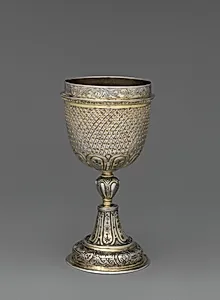
Standing cup (half of a double cup)
early 17th century
Medium
Silver
Dimensions
Overall: 5 3/4 x 2 3/4 x 2 3/4 in. (14.6 x 7 x 7 cm)
Classification
Metalwork-Silver
Culture
Hungarian, Kassa
Department
European Sculpture and Decorative Arts
Museum
Metropolitan Museum of Art, New York, NY
Credit
Gift of The Salgo Trust for Education, New York, in memory of Nicolas M. Salgo, 2010
Accession Number
2010.110.8
Rights
Public Domain
Art Historical Context
This exquisite standing cup, crafted by the Hungarian silversmith Michael Cos de Tarcal in early 17th century, represents one half of a rare double cup set. Made of finely worked silver, it measures a compact 5¾ x 2¾ x 2¾ inches, perfect for elegant display or ceremonial use. Hailing from Kassa (present-day Košice, Slovakia), a thriving center of metalworking in the Kingdom of Hungary, the piece exemplifies the region's masterful silversmithing tradition during a turbulent era of Habsburg-Ottoman conflicts. Double cups like this were prized luxury items among the nobility, often used in pairs for banquets to symbolize harmony, partnership, or even romantic bonds—held together during toasts to prevent spilling. Czikos de Tarcal's work highlights the technical prowess of Hungarian goldsmiths, who employed techniques such as chasing, engraving, and gilding to create ornate, functional art that blended utility with opulence. Today, this cup graces the Metropolitan Museum of Art's European Sculpture and Decorative Arts collection, a generous gift from The Salgo Trust in memory of Nicolas M. Salgo. It offers a tangible glimpse into 17th-century Eastern European elite culture, where silver not only served daily rituals but also conveyed wealth and artistry.
About the Artist
Michael Czikos de Tarcal · 1601–1612
Michael Czikos de Tarcal was a Hungarian silversmith active in Kassa (present-day Košice, Slovakia) from 1601 to 1612, a period when the city thrived as a center for metalworking in the Kingdom of Hungary. Little is known of his early life or training, as records from this era are sparse for craftspeople of his standing, though Kassa's guild system likely shaped his apprenticeship in the local gol...