Ctrl K
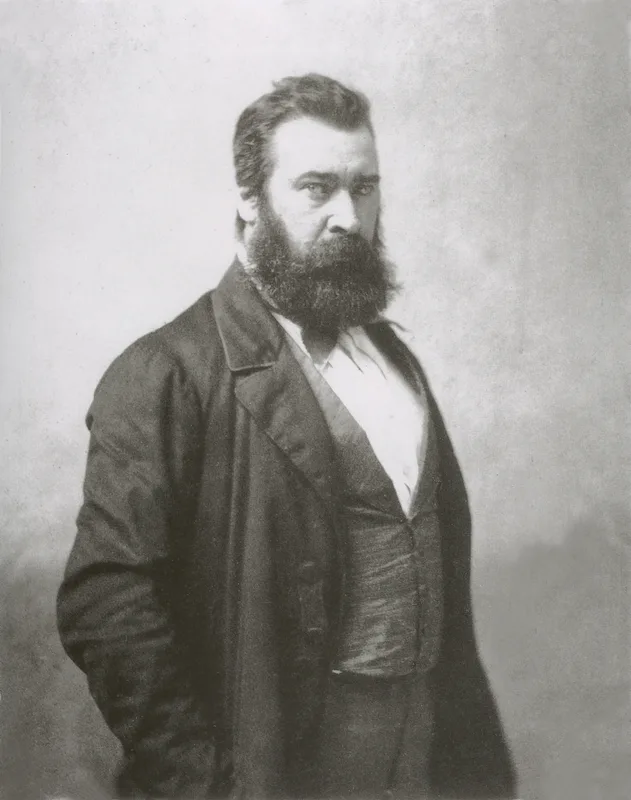
1814–1875
Movements
Occupations
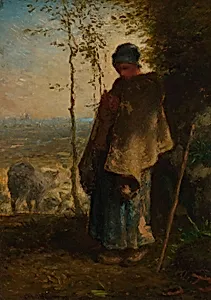
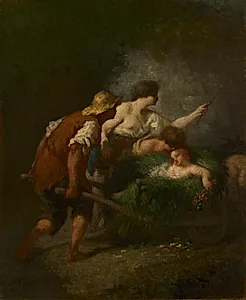
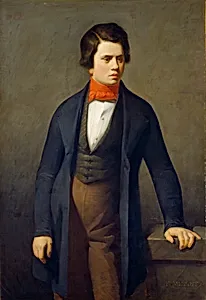
Jean-François Millet (1814-1875) was a French painter and one of the founders of the Barbizon school, whose dignified depictions of peasant laborers transformed how art could represent rural life. His monumental images of sowers, gleaners, and field workers elevated common people to subjects previously reserved for mythological or historical figures, making him a pivotal figure in the development of Realism and a profound influence on subsequent generations of artists. Born to a devout peasant family in Gruchy, Normandy, Millet grew up working the land alongside his education in Latin and classical literature. This dual formation—physical labor and intellectual cultivation—shaped his artistic vision. After training in Cherbourg and Paris, where he studied at the École des Beaux-Arts and frequented the Louvre to study Michelangelo and Poussin, he struggled for recognition with conventional subjects. The cholera epidemic and political upheaval of 1849 prompted his move to Barbizon, a village on the edge of the Fontainebleau forest. There, with Théodore Rousseau, Narcisse Diaz, and other painters, he established what became known as the Barbizon school. While his colleagues painted the forest landscape, Millet turned to the small farms and their inhabitants—the theme that would define his legacy. 'The Gleaners' (1857) and 'The Angelus' (1857-59) became two of the 19th century's most recognized images, their monumental peasant figures set against vast fields capturing both the dignity and difficulty of rural labor. Conservative critics accused him of socialist sympathies, but Millet maintained he painted what he knew: 'A peasant I was born, a peasant I will die.' His influence proved enormous. Vincent van Gogh copied his works more than any other artist, and his impact extended to Seurat, Monet, Dalí, and documentary photographers. The poverty of his family after his death contributed to the establishment of droit de suite legislation, ensuring artists' heirs receive proceeds from resales.
Born to a devout peasant family in Gruchy, Normandy, Millet grew up working the land while receiving education in Latin and classical authors from local priests.
In 1833, he was sent to Cherbourg to study portrait painting with Paul Dumouchel, then with Lucien-Théophile Langlois. A stipend enabled his move to Paris in 1837.
At the École des Beaux-Arts, he studied under Paul Delaroche—an experience he found uncongenial—while spending extensive time at the Louvre studying Michelangelo and Poussin.
His early career involved struggles with conventional subjects including portraits and mythological scenes. Personal tragedy struck when his first wife died of tuberculosis in 1844.
The cholera epidemic and February Revolution of 1848 prompted his departure from Paris in 1849 for the village of Barbizon.
At Barbizon, Millet joined painters Théodore Rousseau, Narcisse Diaz, Constant Troyon, and Charles Jacque. Unlike his colleagues who painted the Fontainebleau forest, Millet focused on the small farms and peasant laborers.
'The Sower' (1850) established his mature approach: a heroic figure monumentalized against the landscape, combining Michelangelo's sculptural grandeur with observed rural reality.
'The Gleaners' (1857) depicted three peasant women gathering leftover grain—a subject conservative critics found inappropriately large-scale for such 'menial' work, though its golden light suggested something sacred in daily labor.
'The Angelus' (1857-59), showing a couple pausing in prayer during the potato harvest, became one of the century's most reproduced images. Millet explained it recalled his grandmother stopping work to pray when church bells rang.
He married Catherine Lemaire in 1853 and raised nine children in chronic financial difficulty, though recognition gradually increased.
After 1864, Millet achieved broader recognition, receiving the Legion of Honor in 1865. His work began commanding higher prices, though financial security remained elusive.
His later paintings showed greater focus on landscape and looser, more gestural brushwork that anticipated Impressionism. 'The Cliffs of Gréville' (1871-72) returned to his Norman homeland with atmospheric freedom.
Late works like 'Bird's-Nesters' (1874) demonstrated explosive movement and emotional intensity that prefigured Expressionism.
Millet died in Barbizon on January 20, 1875. His family's subsequent poverty contributed to the establishment of droit de suite legislation ensuring artists' heirs receive resale proceeds.
Posthumous reputation grew enormously, with 'The Angelus' eventually selling for record prices and inspiring artists from Van Gogh to Dalí.
Wikidata/Wikimedia Commons