Ctrl K
1841–1905
**Oide Tōkō (also known as Toko Oide or Makoto Oide) was a Japanese painter of the late Edo and Meiji periods, born in Edo in 1841 and active until his death in 1905.** He worked primarily in the Nanga (Southern School or literati) tradition, a style rooted in Chinese scholarly painting that emphasized expressive brushwork, poetic subjects, and ink-and-color techniques on silk or paper.
Oide studied under the Nanga master Todo Ryoun (1809–1886), absorbing the school’s emphasis on natural forms and refined compositions. His training positioned him within a lineage of literati artists who blended Chinese influences with Japanese sensibilities during a time of rapid modernization in the Meiji era.
Throughout his career, Oide exhibited widely and earned recognition for his skill. He received a silver medal at the Naikoku Kaiga Kyoshinkai in 1896 and showed works at the Naikoku Kangyo Hakurankai and the Nihon Bijutsu Kyokai. Several of his paintings entered the Imperial Household collection, underscoring his standing among contemporaries.
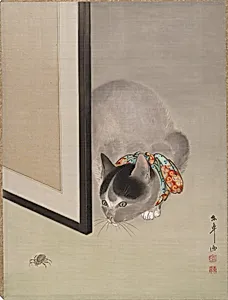
One of his best-known surviving works is the delicate album leaf *Cat Watching a Spider* (ca. 1888–92), executed in ink and color on silk and now held by the Metropolitan Museum of Art. This intimate scene captures a moment of quiet tension with precise yet lively brushwork typical of Nanga animal studies. Oide’s legacy endures through such pieces, which continue to exemplify the graceful fusion of observation and tradition in late-19th-century Japanese painting. His contributions helped sustain the Nanga school amid the rise of Western-influenced art movements.