Ctrl K
1713–1789
Movements
Occupations
Jean-Baptiste Marie Pierre (1714–1789) was born into a prosperous Parisian family of goldsmiths and jewelers; his father, Jean Pierre, became an alderman in 1743, securing noble status for the family. Pierre began his artistic training as a pupil of Nicolas Bertin, followed by study under Charles-Joseph Natoire at the Académie Royale de Peinture et de Sculpture, where he befriended engraver Charles-Nicolas Cochin II and learned etching techniques from Cochin's father. In 1734, at age twenty, he won the prestigious Prix de Rome with *Samson, Whose Hair is Cut by Delilah*, earning a place at the Académie de France in Rome from 1735 to 1740 under directors Nicolas Vleughels and later Jean-François de Troy.
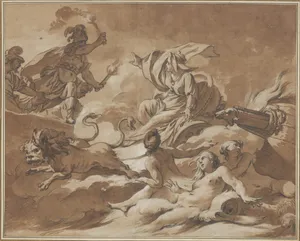
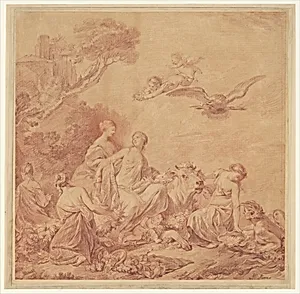
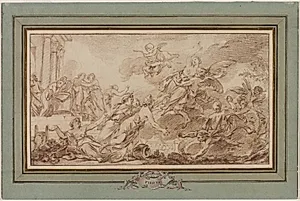
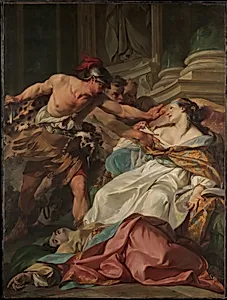
Upon returning to Paris in 1740, Pierre rapidly ascended in the art world. He debuted at the Salon in 1741 with *Psyche, Abandoned by Cupid, Consoled by Nymphs* and was received into the Académie in 1742 with *Diomedes Slain by Hercules* (Musée Fabre, Montpellier). Appointed first painter to the Duc d'Orléans in 1752, he executed ceilings for the Palais-Royal and Château de Saint-Cloud, as well as domes for the church of Saint-Roch (1752–1757). Succeeding François Boucher, he became Premier Peintre du Roi in 1770 and later director of the Académie, wielding significant influence during Louis XVI's reign—though he notoriously opposed admitting women like Élisabeth Vigée Le Brun. Among his notable works are *The Death of Harmonia* (c. 1740–1741, Metropolitan Museum), *Mercury and Io* (c. 1740), *A Bridge* (1749, Louvre), *The Rape of Europa* (1750), and *The Seasons* (1749).
Working firmly in the Rococo tradition, Pierre blended mythological narratives with bambochade elements—lively Italianate scenes of everyday life infused with classical themes—employing a delicate, cooler palette than Boucher's warmer tones, vigorous brushwork, and golden lighting suited to grand decorative commissions. Despite his technical brilliance and mastery of composition, Pierre was overshadowed by Boucher in his lifetime, his prickly personality alienating peers; contemporaries viewed him as secondary, yet his recent rehabilitation highlights his pivotal role in late Rococo history painting. He mentored talents like Étienne-Louis Boullée and Jean-Jacques-François Le Barbier, shaping French art on the eve of Revolution.
Wikidata (CC0); Getty ULAN (ODC-By)