Ctrl K
1751–1831
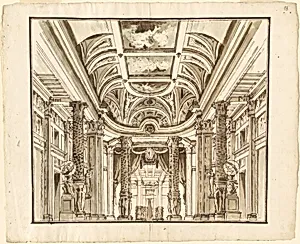
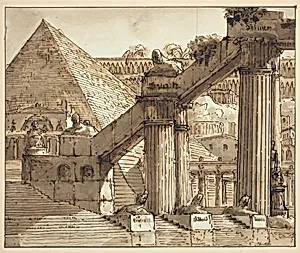
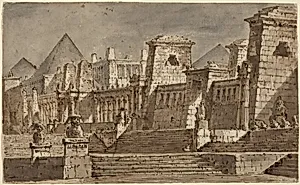
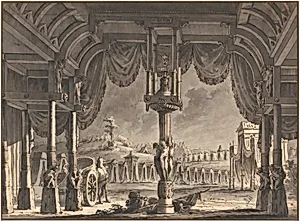
**Pietro di Gottardo Gonzaga** (also known as Pierre Gothard Gonzague) was an Italian theatre set designer, vedutist, and master of chiaroscuro and trompe-l’œil optical illusions, celebrated for his deceptively realistic yet fantastical stage sets. Born on 25 March 1751 in Longarone, Italy, he died on 6 August 1831 in Saint Petersburg, Russia, where he spent the latter part of his career.
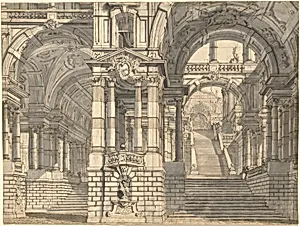
Gonzaga trained in Venice from 1769 to 1772 under Giuseppe Moretti and Antonio Visentini. He drew inspiration from Canaletto, the Bibiena family, Tiepolo, and especially Piranesi. In 1772 he joined the Galliari family’s art firm, and in 1779 he made his solo debut as stage designer at Teatro alla Scala in Milan, remaining there until 1792. During this period he created more than sixty sets for productions in Milan, Genoa, Rome, and Venice, including a notable curtain for La Fenice that became widely imitated.
In 1792 Gonzaga moved to Russia at the invitation of Prince Nikolay Yusupov (or possibly Giacomo Quarenghi), becoming chief decorator for the imperial theatres in Saint Petersburg. He worked there for over thirty years, designing sets for major venues including the Hermitage Theatre and Bolshoy Theatre, as well as court theatres at Gatchina, Pavlovsk, and Peterhof. His innovative use of bold chiaroscuro and shifting perspectives under oil-lamp lighting astonished audiences and earned him the description of his art as “music for the eyes.” He also decorated coronations of Paul I, Alexander I, and Nicholas I, created palace interiors and landscape elements (notably at Pavlovsk), and authored theoretical works such as *La musique des yeux et l’optique théâtrale* (1800).
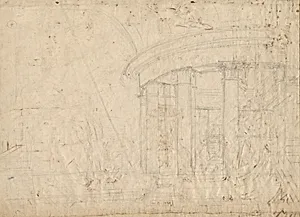
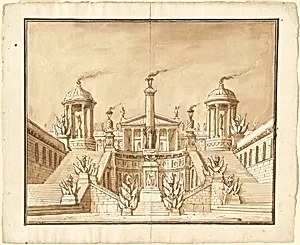
Although Gonzaga yearned to be recognized as an architect and left few permanent structures, his graphic works survive in major collections including the Hermitage Museum, the National Gallery of Art, and the Art Institute of Chicago. Original stage backdrops and a curtain he painted for Yusupov’s private theatre are preserved at the Arkhangelskoye Estate. He is remembered as one of the first artists to elevate scenic design to an independent art form, profoundly influencing Russian theatre and leaving a legacy of illusionistic innovation that continues to be studied and admired.