
Ctrl K
1340–1362
Puccio di Simone (active by ca. 1340–1362) was a prominent Italian Gothic painter based in Florence during the mid-14th century. Little is known of his early life, which remains sparsely documented, but by 1346–1348 he was enrolled in Florence's Arte dei Medici e Speziali, the guild for painters and apothecaries, indicating his established status. He studied under Bernardo Daddi, the leading Florentine artist of the generation, whose influence is evident in Puccio's refined Gothic style—characterized by delicate figures, gold-ground panels, and intricate narrative details. A document from 1348–1349 lists him among Florence's top painters, underscoring his rapid rise.
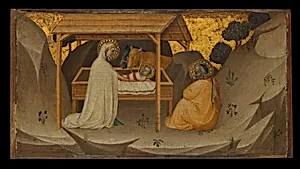
Puccio worked firmly in the Florentine Gothic tradition, blending Daddi's linear elegance with subtle Sienese influences. His signed polyptych, *Triptych of the Madonna with Saints Laurentius, Onuphrius, Jacobus, and Barthomoleus* (ca. 1350s), in Florence's Galleria dell'Accademia, exemplifies his mastery of devotional altarpieces, with its luminous tempera and crowded saintly gatherings. Other key works include *Saints Lucia and Catherine* (Galleria di Palazzo degli Alberti, Prato), *St. Ansano and Two Angels* (Church of Saints Giovanni Battista and Ansano, Vinci), *Madonna with Angels and Saints* (National Gallery of Art, Washington, D.C.), *St. James Major* (Seattle Art Museum), *Crucifixion* (Snite Museum of Art, University of Notre Dame), *Adoration of the Kings* (Worcester Art Museum), and *The Nativity* (ca. 1350, Metropolitan Museum of Art). These panels showcase his skill in polyptychs and private devotions, often featuring elongated figures and vibrant punchwork.
Around 1353–1354, Puccio ventured to the Marches region, collaborating with Allegretto Nuzi in Fabriano, as seen in works like *Saint Anthony with Donors* (Pinacoteca Civique, Fabriano). Long misattributed to the anonymous "Master of the Fabriano Altarpiece," his oeuvre was clarified by scholars like Roberto Longhi and Richard Offner in the 20th century. Puccio's legacy endures in his bridge between Giottesque naturalism and later International Gothic, preserving Florence's 14th-century pictorial heritage across major museums. His brief but prolific career highlights the vibrancy of Trecento painting amid the Black Death's shadow.
(Word count: 348)
![Saint Anthony Abbot [left panel]](https://images.artheonmuseum.org/nga/thumb/saint-anthony-abbot-left-panel-nga-6.webp)
![Madonna and Child Enthroned with Saints and Angels, and Saints Anthony Abbot and Venantius [entire triptych]](https://images.artheonmuseum.org/nga/thumb/madonna-and-child-enthroned-with-saints-and-nga-206126.webp)
![Madonna and Child Enthroned with Four Saints and Eighteen Angels [middle panel]](https://images.artheonmuseum.org/nga/thumb/madonna-and-child-enthroned-with-four-saints-and-nga-7.webp)
![Saint Venantius [right panel]](https://images.artheonmuseum.org/nga/thumb/saint-venantius-right-panel-nga-8.webp)