
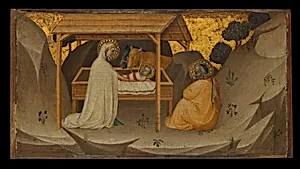
The Nativity
ca. 1350
Medium
Tempera on wood, gold ground
Dimensions
7 7/8 x 15 in. (20 x 38.1 cm)
Classification
Paintings
Department
Robert Lehman Collection
Museum
Metropolitan Museum of Art, New York, NY
Credit
Robert Lehman Collection, 1975
Accession Number
1975.1.105
Rights
Public Domain
Tags
Art Historical Context
Created around 1350 by the Florentine painter Puccio di Simone, *The Nativity* captures a tender moment from the Christian story of Christ’s birth. This small tempera panel, measuring just under eight inches high, likely served as a portable devotional object or part of a larger altarpiece. In the intimate scene, the Virgin Mary kneels in quiet reverence beside the Christ Child, accompanied by saints who bear witness to the sacred event. Puccio di Simone worked in the refined tradition of mid-fourteenth-century Italian painting, employing egg-tempera on a wooden support with a luminous gold ground. The gold background was not merely decorative; it evoked the heavenly realm and drew the viewer’s attention to the holy figures. Such works were central to personal and communal worship during a time when art helped the faithful meditate on key moments of salvation history. Today housed in the Metropolitan Museum of Art’s Robert Lehman Collection, the painting offers a window into the devotional life of the late Middle Ages. Its compact size and glowing surface remind us how artists of this era combined exquisite craftsmanship with deep spiritual purpose.
About the Artist
Puccio di Simone · 1340–1362
Puccio di Simone (active by ca. 1340–1362) was a prominent Italian Gothic painter based in Florence during the mid-14th century. Little is known of his early life, which remains sparsely documented, but by 1346–1348 he was enrolled in Florence's Arte dei Medici e Speziali, the guild for painters and apothecaries, indicating his established status. He studied under Bernardo Daddi, the leading Flore...