
Ctrl K
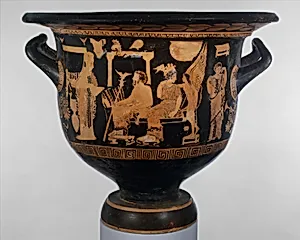
**The Sarpedon Painter** was an Apulian vase painter active in South Italy during the Late Classical period, roughly 400–370 BCE. Working in the red-figure technique characteristic of Greek colonial workshops in Apulia, he specialized in large mixing vessels such as bell-kraters and volute-kraters. His name derives from his distinctive treatment of mythological scenes involving the Trojan hero Sarpedon, reflecting both Homeric tradition and contemporary theatrical influences.
Little is known of his training or personal life, as is typical for most South Italian artisans whose identities survive only through stylistic attributions. He belonged to the vibrant Apulian red-figure tradition that flourished in centers like Tarentum, adapting Athenian innovations to local tastes with elaborate compositions, rich ornament, and narrative depth. His work shows close affinities with other painters of the early fourth century, including those producing fragments now in collections such as the J. Paul Getty Museum.
The painter’s principal surviving work is a terracotta bell-krater in the Metropolitan Museum of Art (acc. no. 16.140), dated circa 400–380 BCE. Its obverse depicts Europa pleading with Zeus for Sarpedon’s life, accompanied by Hera, Hypnos, and Pasithea; the reverse shows Europa observing Hypnos and Thanatos carrying Sarpedon’s body. These scenes likely draw on Aeschylus’s lost play *Europa* or *Carians*, blending epic narrative with dramatic staging. The vase’s theatrical props and compositional complexity highlight the painter’s skill in translating stage imagery onto pottery.
Though only a handful of pieces are firmly attributed to him, the Sarpedon Painter contributed to the rich corpus of Apulian vase painting that supplied funerary and domestic needs across Magna Graecia. His mythological subjects helped preserve and reinterpret Greek literary traditions in a colonial context, ensuring that stories of heroes like Sarpedon continued to resonate in the Greek West long after the height of Athenian vase production.