
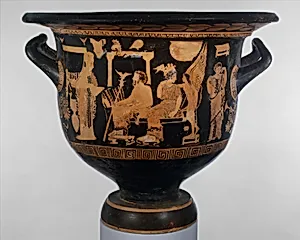
Terracotta bell-krater (mixing bowl)
ca. 400–380 BCE
Medium
Terracotta
Dimensions
H. 19 5/8 in. (49.9 cm) diameter of mouth 22 3/8 in. (56.8 cm)
Classification
Vases
Culture & Period
Greek, South Italian, Apulian · Late Classical
Department
Greek and Roman Art
Museum
Metropolitan Museum of Art, New York, NY
Credit
Rogers Fund, 1916
Accession Number
16.140
Rights
Public Domain
Tags
Art Historical Context
This terracotta bell-krater, created around 400–380 BCE in Apulia, South Italy, served as a practical mixing bowl for diluting wine with water during Greek symposia and rituals. Produced during the Late Classical period, it exemplifies the vibrant ceramic tradition of Magna Graecia, where Greek colonists adapted mainland styles to local tastes. Its generous proportions—nearly 20 inches tall with a wide mouth—made it ideal for communal gatherings, underscoring wine’s central role in social and religious life. Attributed to the Sarpedon Painter, the vessel features red-figure decoration typical of Apulian vases, with lively scenes involving Zeus, Hera, and attendant figures. The artist’s fluid lines and expressive poses bring mythological narratives to life on the curved surface, inviting viewers to circle the bowl and discover the story from multiple angles. Such vases often bridged everyday use and storytelling, preserving Greek myths for both Greek settlers and indigenous communities. Acquired by the Metropolitan Museum in 1916, this krater highlights how South Italian workshops expanded classical art beyond Athens, blending Athenian techniques with regional flair to create objects that were both functional and richly symbolic.
About the Artist
Sarpedon Painter
**The Sarpedon Painter** was an Apulian vase painter active in South Italy during the Late Classical period, roughly 400–370 BCE. Working in the red-figure technique characteristic of Greek colonial workshops in Apulia, he specialized in large mixing vessels such as bell-kraters and volute-kraters. His name derives from his distinctive treatment of mythological scenes involving the Trojan hero Sar...