Ctrl K
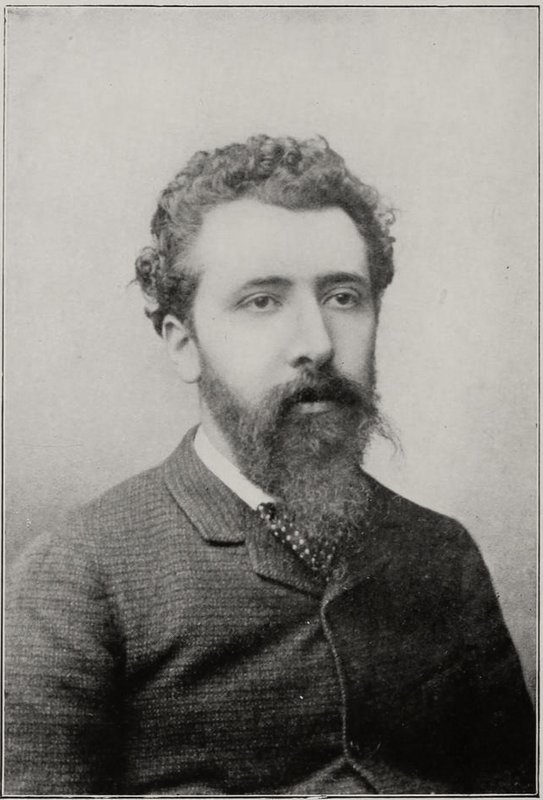
1859–1891
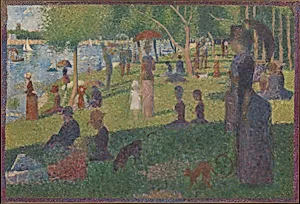
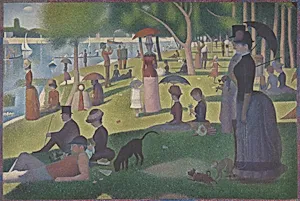
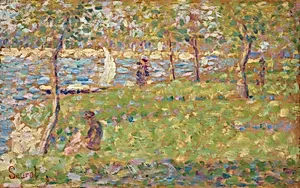
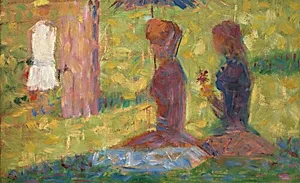
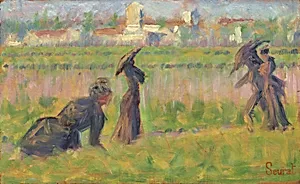
Georges Seurat (1859-1891) was the founder of Neo-Impressionism and the inventor of Pointillism, a revolutionary technique that transformed how artists understand and apply color. In a tragically brief career cut short at age 31, Seurat produced only seven monumental paintings, yet his systematic application of color theory fundamentally altered the direction of modern art. Born in Paris to a prosperous family, Seurat received classical training at the École des Beaux-Arts under Henri Lehmann, a disciple of Ingres. However, the Fourth Impressionist exhibition of 1879 profoundly influenced his direction. Rather than rejecting Impressionism, he sought to place its insights on a scientific foundation, studying the color theories of Michel-Eugène Chevreul, Charles Blanc, and Ogden Rood. Seurat developed what he called 'chromo-luminism'—the technique better known as Pointillism or Divisionism—applying tiny dots of contrasting colors that optically mix when viewed from a distance to create luminous, shimmering effects impossible to achieve through conventional pigment mixing. His artistic personality combined extreme sensibility with 'a passion for logical abstraction and an almost mathematical precision of mind.' His masterpiece, 'A Sunday Afternoon on the Island of La Grande Jatte' (1884-86), required two years and dozens of preparatory studies. When exhibited at the final Impressionist exhibition in 1886, it established Neo-Impressionism as a movement and became one of the icons of late 19th-century painting. Seurat died suddenly of a fever in March 1891, leaving his final painting 'The Circus' unfinished. Despite his brief career, his innovations influenced Post-Impressionists including Van Gogh and Gauguin, and his systematic approach to color anticipated Fauvism, Cubism, and Op Art. As he stated, 'Great things are done by a series of small things brought together.'
Seurat's formal artistic training began around 1875 under sculptor Justin Lequien, developing his exceptional drawing skills that would distinguish his entire career.
From 1878-1879, he studied at the École des Beaux-Arts under Henri Lehmann, a Neo-Classical disciple of Ingres, absorbing the discipline of academic composition and draftsmanship.
He spent significant time in museums studying Old Masters—Holbein, Poussin, and Raphael—developing his appreciation for classical form and monumental composition.
The Fourth Impressionist exhibition in 1879 profoundly influenced his direction, introducing him to contemporary approaches to light and color that would inform his later innovations.
In the early 1880s, Seurat immersed himself in color theory, reading Michel-Eugène Chevreul's 'The Principles of Harmony and Contrast of Colors' (1839), Charles Blanc's 'The Grammar of Painting and Engraving' (1867), and Ogden Rood's 'Modern Chromatics' (1879).
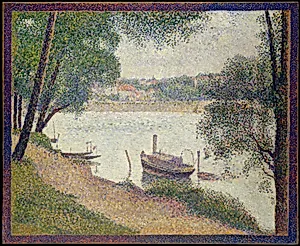
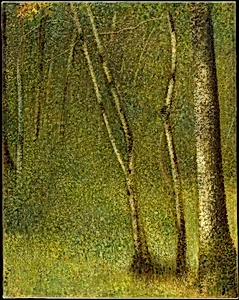
He developed his technique of 'chromo-luminism,' placing tiny dots of contrasting color that optically mix when viewed from a distance, creating effects of unprecedented luminosity.
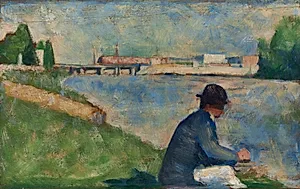
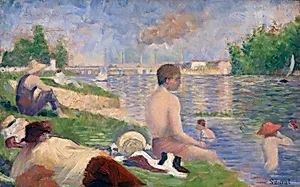
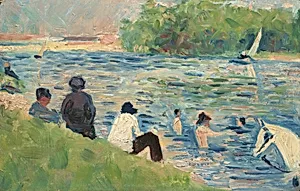
'Bathers at Asnières' (1884), his first monumental work, established his combination of classical composition with modern subject matter and systematic color application.
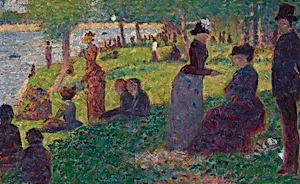
The two-year labor on 'A Sunday Afternoon on the Island of La Grande Jatte' (1884-86) produced his masterpiece and, when exhibited at the final Impressionist show in 1886, launched Neo-Impressionism as a recognized movement.
Seurat's later work moved toward more dynamic compositions influenced by popular entertainment, caricature, and contemporary posters.
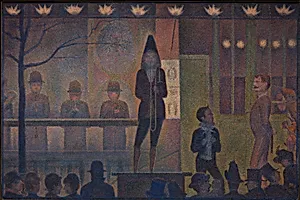
He produced his first nocturnal painting, 'Circus Sideshow' (1887-88), depicting a ringmaster under gaslight, and explored circus and nightlife subjects that connected his work to Symbolist interests.
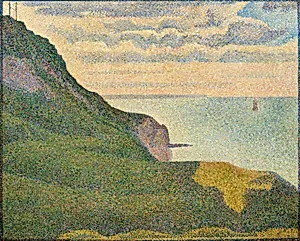
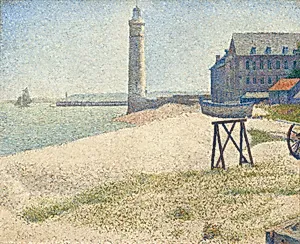
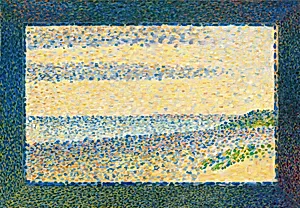
He spent summers on the Normandy coast at Honfleur, Port-en-Bessin, Le Crotoy, and Gravelines, creating luminous seascapes and harbor scenes while completing major works in his winter studio.
His final painting, 'The Circus' (1890-91), was left unfinished when he died suddenly of a fever on March 29, 1891, at age 31, just weeks after his secret companion Madeleine Knobloch had borne their second child.