Ctrl K
1740
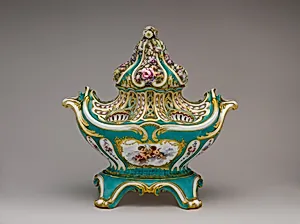
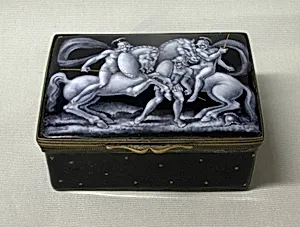
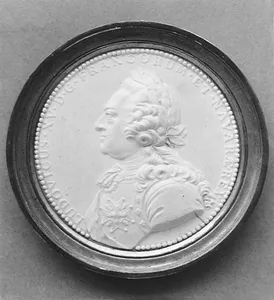
The Sèvres Manufactory, one of Europe's premier porcelain producers, was established in 1740 as the Manufacture de Vincennes under the patronage of Queen Marie Leszczyńska, who sought to rival Meissen and Chantilly porcelains with French soft-paste innovations. Initially a private venture, it relocated to Sèvres in 1756 in a purpose-built facility designed by architect Laurent Lindet near Madame de Pompadour's Château de Bellevue, and was acquired by Louis XV in 1759, placing it under royal control with Pompadour as a key overseer. Jean-Claude Chambellan Duplessis served as artistic director from 1748 to 1774, guiding the Rococo style characterized by playful painted motifs on restrained forms, as seen in the 1764 Sèvres pot-pourri vase in the shape of a ship and the c. 1760 elephant vase with candleholders. Biscuit porcelain—unglazed, matte white figures—emerged early, exemplified by the 1764 Annette and Lubin group.
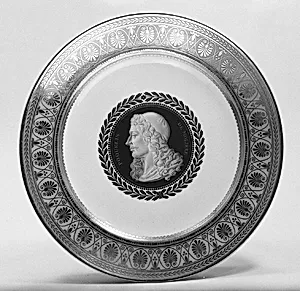
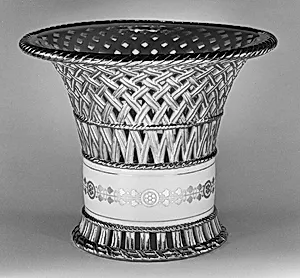
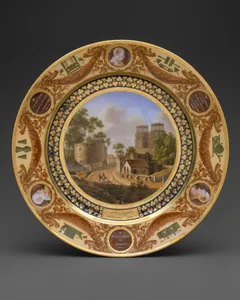
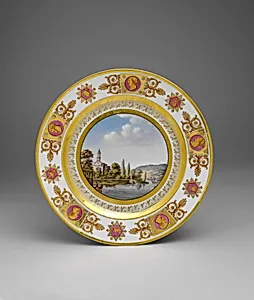
Under directors Louis-Simon Boizot (1774–1800) and especially Alexandre Brongniart (1800–1847), Sèvres transitioned to hard-paste porcelain after the 1768 kaolin discovery near Limoges, fully abandoning soft-paste by 1804. Brongniart, an engineer, revolutionized production with new enamels, efficient kilns, and eclectic styles blending Neoclassicism, Empire motifs (lavish gilding, Neo-Egyptian elements post-Napoleon's campaigns), and historical revivals like Gothic and Renaissance-inspired pieces. Notable commissions included the 1784 service for Marie Antoinette with rich colors and gold, the Sèvres Egyptian Service under Napoleon, and Brongniart-era diplomatic tablewares like the 1827 Service des Départements featuring regional views. Painters such as Martin Drolling and Abraham Constantin, alongside designers like Alexandre-Évariste Fragonard (son of Jean-Honoré Fragonard), contributed to masterpieces including the 1837 vase depicting Louis-Philippe I.
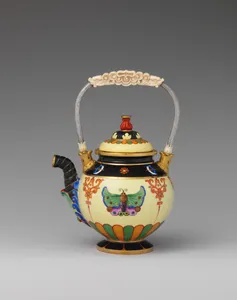
In the late 19th and 20th centuries, Sèvres embraced Japonisme post-1870, Art Nouveau from 1897 under A. Sandier, and Art Deco influences, with directors like Henri Victor Regnault (from 1854) and Albert-Ernest Carrier-Belleuse driving innovations such as the 1867 Neptune vase (3.15m tall for the Universal Exhibition). Relocated to state-of-the-art buildings in 1875, it endured wars—producing stoneware in WWI and suffering WWII bombings—while hosting the 1920 Treaty of Sèvres. Today, as part of the Cité de la céramique – Sèvres et Limoges (since 2012), it crafts limited-edition ceramics blending tradition and contemporary design, sustaining its legacy as a royal-turned-national beacon of ceramic artistry.