
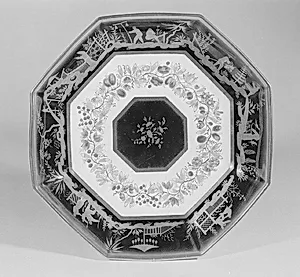
Dish
1804–13
Medium
Hard-paste porcelain
Dimensions
Diameter: 9 7/8 in. (25.1 cm)
Classification
Ceramics-Porcelain
Culture
French, Sèvres
Department
European Sculpture and Decorative Arts
Museum
Metropolitan Museum of Art, New York, NY
Credit
Gift of Lewis Einstein, 1962
Accession Number
62.165.40
Rights
Public Domain
Tags
Art Historical Context
This elegant dish from the Sèvres Manuf, created between 1804 and 1813, exemplifies the pinnacle of French porcelain artistry during the Napoleonic Empire Measuring nearly 10 inches in diameter, it crafted from hard-paste porcelain—a technically advanced medium developed in Europe to rival fine Chinese imports. Fired at extremely high temperatures, hard-paste porcelain achieves exceptional translucency, strength, and a pure white body, allowing for intricate painting and gilding that withstands the kiln's heat. Sèvres, the royal porcelain factory near Paris, was renowned for its luxury ceramics patronized by monarchs and emperors, including Napoleon. Pieces like this dish were status symbols for the elite, often featuring delicate floral motifs (as suggested by its tags) in vibrant enamels. The Empire style emphasized neoclassical grandeur with refined decoration, blending technical innovation and aesthetic opulence. Today, this dish graces the Metropolitan Museum of Art's European Sculpture and Decorative Arts collection, a gift from Lewis Einstein in 1962. It invites us to appreciate the fusion of science and artistry in everyday luxury, a testament to France's enduring ceramic legacy.
About the Artist
Sèvres Manufactory · 1740–present
The Sèvres Manufactory, one of Europe's premier porcelain producers, was established in 1740 as the Manufacture de Vincennes under the patronage of Queen Marie Leszczyńska, who sought to rival Meissen and Chantilly porcelains with French soft-paste innovations. Initially a private venture, it relocated to Sèvres in 1756 in a purpose-built facility designed by architect Laurent Lindet near Madame d...