
Ctrl K
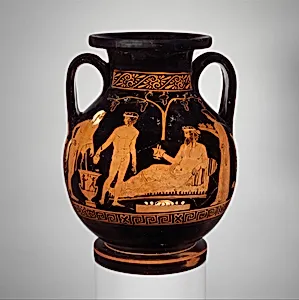
**The Somzée Painter** was an anonymous Attic vase painter active in Athens during the late fifth century BCE, specifically around 420–410 BCE. Like many ancient Greek artisans of his era, his personal biography remains unknown; no records survive of his early life, training, or family. He is identified today solely through stylistic analysis of surviving pottery, a method pioneered by scholars such as J. D. Beazley. His conventional name derives from the Somzée collection, in which one of his works once appeared.
Working firmly within the **Attic red-figure tradition**, the Somzée Painter produced finely detailed vessels that reflect the refined aesthetic of the Classical period. His figures display substantial forms, individualized characterizations, and delicate line work, particularly in the rendering of drapery and natural elements. The single known work securely attributed to him—a terracotta pelike (jar) now in the Metropolitan Museum of Art—exemplifies these qualities. On the obverse, Dionysos reclines outdoors on a couch beneath a spreading vine, attended by a youth and an elderly satyr; the reverse shows three youths. The scene evokes the sensual pleasures of the symposium while integrating landscape elements in a manner that anticipates later Western depictions of outdoor gatherings.
Although only this one vase is firmly linked to the painter, his output contributes to our understanding of late-fifth-century Athenian iconography and workshop practices. The pelike’s sophisticated composition and attention to naturalistic detail place him among the competent, if not leading, figures of the red-figure school during Athens’s cultural peak. His work survives as a modest but eloquent testament to the vitality of Attic vase painting at the close of the Classical era.