
Ctrl K
1751–1801
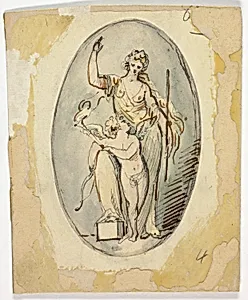
William Hamilton RA (1751–1801) was born in Chelsea, London, into a family connected to architecture; his father assisted the renowned neoclassical designer Robert Adam. Hamilton initially trained as an architectural draftsman before pursuing painting, entering the Royal Academy Schools in 1769. He soon traveled to Italy, where he worked with the painter Antonio Zucchi for several years, honing his skills in history painting and illustration.)
Upon returning to England, Hamilton established himself as a prominent history painter and illustrator, specializing in theatrical portraits and dramatic scenes from Shakespearean plays. His style drew from the cult of sentiment, echoing the elegant neoclassicism of Angelica Kauffman, while occasionally incorporating the intense distortions of Henry Fuseli. Elected an Associate of the Royal Academy in 1784 and a full Academician in 1789, he exhibited battle scenes and literary subjects, blending modern events with epic grandeur.)
Among his major works are *King Edgar's First Interview with Queen Elfrida* (1774), *Prospero and Ariel* (1797) for John Boydell's Shakespeare Gallery, and *The Death of Arthur*. He contributed illustrations to Thomas Macklin's Bible and Robert Bowyer's *History of England*, with engravings by Francesco Bartolozzi amplifying their reach. Theatrical portraits, such as Sarah Siddons as Euphrasia (1784) and John Philip Kemble as Richard III (c. 1787), captured the era's dramatic fervor, while poignant depictions like *Marie Antoinette Being Taken to Her Execution* (1794) treated contemporary tragedy as classical myth.)
Hamilton's legacy endures through his vivid Shakespearean interpretations, which popularized literary themes in British art and influenced print culture. His works, now in collections like the National Galleries of Scotland and Victoria and Albert Museum, exemplify the late 18th-century fusion of sentiment, theater, and history painting, bridging neoclassicism and Romanticism.)