
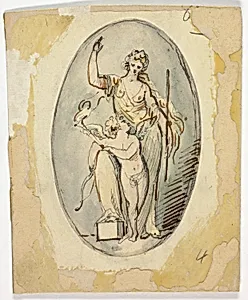
Venus and Cupid
Medium
Pen and brown and gray ink, with watercolor, on ivory wove paper, laid down on board
Dimensions
12 × 7.8 cm (4 3/4 × 3 1/8 in.)
Classification
pen and ink drawings
Department
Prints and Drawings
Museum
Art Institute of Chicago
Accession Number
115420
Rights
Public Domain
Art Historical Context
In the delicate *Venus and Cupid*, created the style of British artist William Hamilton (17511801), the Roman goddess of love tenderly attends to her son, the mischievous god of desire. Hamilton, a prominent figure in late 18th-century British art, drew inspiration from classical mythology, blending neoclassical elegance with romantic sentiment. This intimate drawing captures a timeless mother-child bond infused with erotic undertones, a motif popularized in art from the Renaissance through the Enlightenment, evoking works by Titian or Rubens. Executed in pen and brown and gray ink with watercolor on ivory wove paper—laid down on board for preservation—this miniature (just 12 × 7.8 cm) showcases virtuoso draftsmanship. The fine lines and subtle washes create depth and luminosity, ideal for a preparatory sketch or collector's gem. Such mixed-media techniques were prized in the era's print culture, where Hamilton often supplied designs for engravings, bridging painting and reproductive art. Housed in the Art Institute of Chicago's Prints and Drawings Department, this undated work reflects the era's fascination with antiquity amid Europe's Grand Tour fervor. Visitors will appreciate its charm as a window into 18th-century taste for mythological reverie, perfect for quiet contemplation.
About the Artist
Style of William Hamilton · 1751–1801
William Hamilton RA (1751–1801) was born in Chelsea, London, into a family connected to architecture; his father assisted the renowned neoclassical designer Robert Adam. Hamilton initially trained as an architectural draftsman before pursuing painting, entering the Royal Academy Schools in 1769. He soon traveled to Italy, where he worked with the painter Antonio Zucchi for several years, honing hi...