Ctrl K
1528–1598
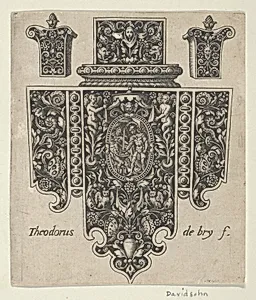
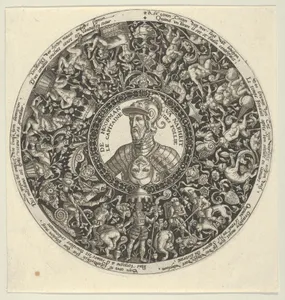
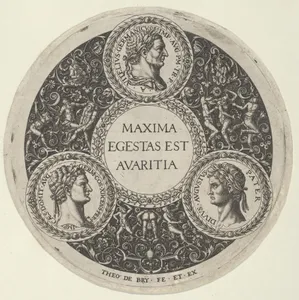
Theodor de Bry was born in 1528 in Liège, in what is now Belgium, into a family of jewelers and engravers. Trained as a goldsmith and copper-plate engraver — skills he refined under his grandfather, Thiry de Bry the Elder — he worked across several European cities before religious persecution forced him into exile. As a Protestant living under Spanish rule in the Southern Netherlands, de Bry was sentenced to banishment around 1570 and his goods confiscated. He spent years in Strasbourg, Antwerp, and London before settling permanently in Frankfurt-am-Main in 1588, where he became a citizen and launched his publishing enterprise.
In London, de Bry met the geographer Richard Hakluyt and began gathering illustrations and accounts of European exploration, including watercolor paintings by colonist John White and survivor Jacques Le Moyne de Morgues. These encounters would define the rest of his career. In 1590, his Frankfurt workshop published an illustrated edition of Thomas Harriot's A Briefe and True Report of the New Found Land of Virginia, followed the next year by an illustrated account of French attempts to colonize Florida featuring 43 engravings derived from Le Moyne's paintings of Fort Caroline. These were the first volumes in what became his monumental series, the Collectiones peregrinatiorum — also known as Les Grands Voyages, or 'The Great Travels' — which documented European expeditions across the Americas, Africa, and Asia.
De Bry himself never visited the places he depicted, and his engravings sometimes filtered indigenous peoples through a European visual vocabulary, rendering them with classical proportions. Nevertheless, his publications circulated widely in Latin, German, English, and French editions, and profoundly shaped how Europeans imagined the wider world. The series was continued by his sons after his death in Frankfurt in 1598, extending his legacy across several more decades. As one of the first systematic publishers of illustrated travel literature, de Bry occupies a singular place at the intersection of printmaking, cartography, and the European encounter with the Americas.