
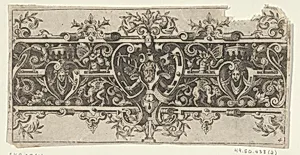
Frieze with Grotesques and a Horned and Bearded Figure Between Strapwork at Center
1589
Medium
Engraving
Dimensions
Sheet: 2 13/16 × 5 3/4 in. (7.2 × 14.6 cm)
Classification
Prints|Ornament & Architecture
Department
Drawings and Prints
Museum
Metropolitan Museum of Art, New York, NY
Credit
The Elisha Whittelsey Collection, The Elisha Whittelsey Fund, 1949
Accession Number
49.50.433(2)
Rights
Public Domain
Tags
Art Historical Context
In the late Renaissance, Flemish engraver Theodor de Bry intricate ornamental designs that captivated artists, architects, and craftsmen across Europe This 1589 engraving *Frieze with Grotesques and a Horned andarded Figure Between Strap at Center*, exemplifies his mastery of the medium. Measuring just 2 13/16 × 5 3/4 inches, the delicate print features a fantastical frieze alive with swirling grotesques—intertwined mythical creatures, foliage, and strapwork framing a central horned, bearded figure. Produced on a small scale, it was ideal for pattern books, allowing widespread dissemination of decorative motifs. Grotesques, revived from ancient Roman frescoes discovered in Nero's Domus Aurea, became a hallmark of Renaissance ornamentation, blending the natural and supernatural in playful, asymmetrical patterns. De Bry's precise engraving technique—using burin to create fine lines and rich tonal contrasts—brought these motifs to life with remarkable clarity and depth, influencing Mannerist styles in architecture, textiles, and metalwork. Housed in the Metropolitan Museum of Art's Drawings and Prints department, this piece from The Elisha Whittelsey Collection highlights the era's fascination with classical revival and exotic fantasy. It invites visitors to imagine it adorning a grand hall or gilded frame, a testament to printmaking's power in shaping visual culture.
About the Artist
Theodor de Bry · 1528–1598
Theodor de Bry was born in 1528 in Liège, in what is now Belgium, into a family of jewelers and engravers. Trained as a goldsmith and copper-plate engraver — skills he refined under his grandfather, Thiry de Bry the Elder — he worked across several European cities before religious persecution forced him into exile. As a Protestant living under Spanish rule in the Southern Netherlands, de Bry was s...