Ctrl K
1714–1778
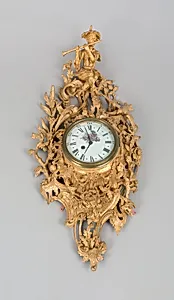
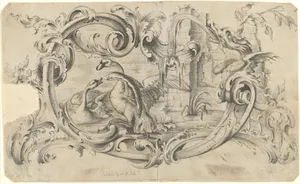
**Thomas Johnson (1714–1778)** was an English wood carver and furniture maker renowned for his exuberant Rococo designs that blended rococo, Chinese, Gothic, and rustic motifs with remarkable vitality and flamboyance. Working primarily in London during the mid-eighteenth century, he became one of the most successful and distinctive exponents of the British Rococo style, often incorporating human figures, animals, birds, and scenes drawn from Francis Barlow’s illustrations of Aesop’s Fables into furniture and ornamental carvings.)
Johnson’s training began early. Orphaned young, he was apprenticed in 1737 to his cousin, the carver and gilder Robert Johnson, in Soho. He later worked as a journeyman for James Whittle, where he encountered the celebrated carver and draughtsman Matthias Lock, who taught him drawing and refined his carving skills. Johnson also spent time working in Liverpool and Dublin before returning to London, where he established his own workshop, “The Golden Boy,” and took on apprentices.
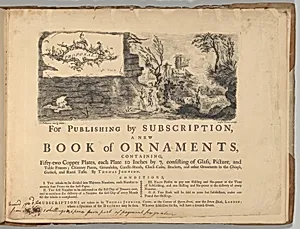
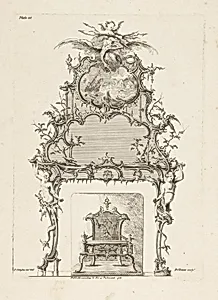
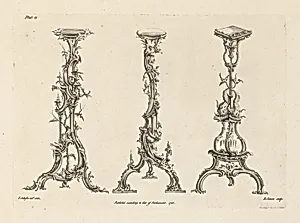
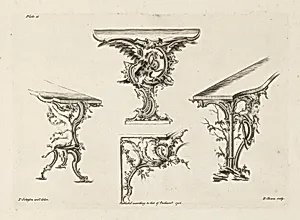
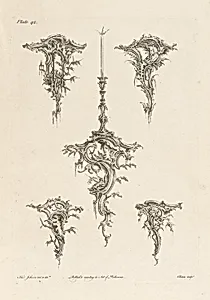
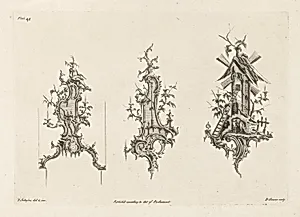
His artistic output centered on published design books that disseminated his inventive ornament. Key publications include *Twelve Girandoles* (1755), *One Hundred and Fifty New Designs* (1761), and volumes of designs for picture frames, candelabra, ceilings, and chimney pieces. These works, often engraved after his drawings, featured extreme mixtures of motifs and influenced contemporaries such as Ince and Mayhew. Surviving examples of his designs, including a tablet for a chimney-piece with courting swans (1762) and table supports illustrating Aesop’s fables, demonstrate his lively, pictorial approach.)
Johnson’s legacy rests on his role in shaping mid-Georgian decorative arts. Though his personal carving output is less documented than his prints, his bold interpretations of Rococo gave the style a distinctly English energy. His designs continued to inspire furniture makers and carvers, and his rediscovered autobiography has illuminated the life of a talented yet financially challenged craftsman who also taught drawing and later engaged deeply with Freemasonry. Today, his work is held in major collections, including the Victoria and Albert Museum and the Metropolitan Museum of Art.