
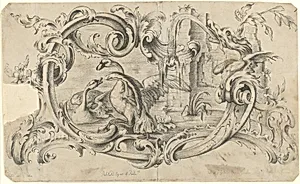
Design for a Tablet for a Chimney-Piece with Two Swans in Combat, Enclosed within a Scrolling Cartouche with a Water-Spouting Dragon's Head
1762
Medium
Crayon manner and stipple engraving
Dimensions
sheet: 8 x 13 1/16 in. (20.3 x 33.2 cm)
Classification
Prints|Ornament & Architecture
Department
Drawings and Prints
Museum
Metropolitan Museum of Art, New York, NY
Credit
Gift of Harvey Smith, 1985
Accession Number
1985.1099
Rights
Public Domain
Tags
Art Historical Context
In the opulent world of 18th-century interior design, Thomas Johnson's *Design for a Tablet for Chimney-Piece with Swans in Combat,closed within a Scrollingouche with a Water-Sp Dragon's Head* (2) captures the playful drama of Rococo ornamentation. This intricate print depicts two fierce swans locked in battle within an elaborate, scrolling cartouche—a decorative frame—topped by a fantastical dragon's head sp water. Intended as a panel for a fireplace mantel (chimney-piece), it the era's fascination with dynamic natural motifs, blending avian grace with mythical ferocity to adorn grand homes. Crafted in crayon manner and stipple engraving, Johnson's technique mimics the soft, textured strokes of chalk drawings through dotted patterns, creating rich tonal depth on a modest sheet of 8 x 13 1/16 inches. These innovative print methods, popular in mid-1700s Britain, allowed designers like Johnson—a prolific engraver of furniture and architectural patterns—to disseminate elaborate motifs affordably to carvers, gilders, and cabinetmakers. Housed in the Metropolitan Museum of Art's Drawings and Prints department (gift of Harvey Smith, 1985), this work highlights the ornamental print's role in fueling the decorative arts boom. Swans and dragons evoke classical mythology and exotic whimsy, inviting visitors to imagine them gleaming in gold leaf above a roaring hearth.
About the Artist
Thomas Johnson · 1714–1778
**Thomas Johnson (1714–1778)** was an English wood carver and furniture maker renowned for his exuberant Rococo designs that blended rococo, Chinese, Gothic, and rustic motifs with remarkable vitality and flamboyance. Working primarily in London during the mid-eighteenth century, he became one of the most successful and distinctive exponents of the British Rococo style, often incorporating human f...