Ctrl K
1886–1949
**Walter G. Capuozzo** (c. 1886–1949) was an American artist born in Italy whose career intersected with one of the most ambitious documentation projects in U.S. art history. Little is known about his early life or formal training, which remains sparsely documented, but by the late 1930s, Capuozzo had established himself in New York, contributing detailed renderings to the Index of American Design (IAD). This New Deal-era initiative, launched in 1935 under the Federal Art Project, employed artists nationwide to create watercolor illustrations of everyday American folk objects, crafts, and decorative arts, preserving their cultural significance amid the Great Depression.
Capuozzo worked in the precise, documentary style championed by the IAD, employing watercolor, graphite, colored pencil, gouache, pen and ink, and subtle heightening on paperboard to capture the textures, forms, and historical nuances of vernacular objects. His illustrations evoke the functionality and artistry of early American craftsmanship, blending technical accuracy with subtle aesthetic appreciation—hallmarks of the project's goal to elevate folk design as national heritage. Though not formally tied to a specific art school or movement beyond the IAD, his output reflects the era's emphasis on realism and cultural inventory, akin to the works of contemporaries like William Henry Holmes or later folk art chroniclers.
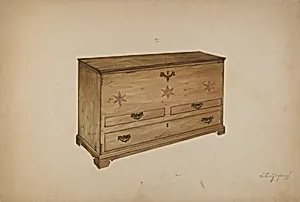
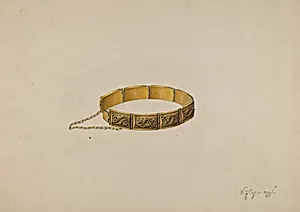
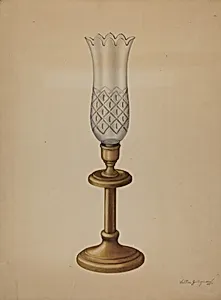
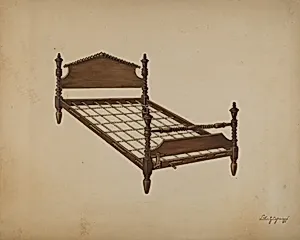
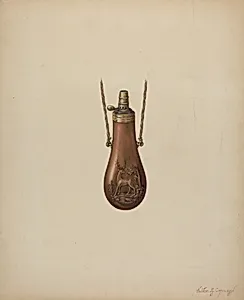
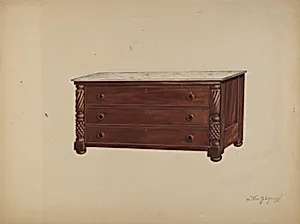
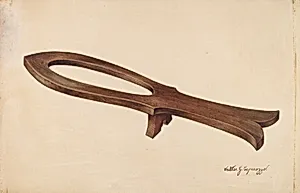
Among his major contributions to the National Gallery of Art's IAD holdings are vivid depictions such as *Rope Bed* (c. 1939), showcasing a wooden frame with taut rope supports; *Lamp* (c. 1939), a graceful wood-and-metal fixture; *Chest with Drawers* (c. 1939 and 1935/1942); *Bracelet* (c. 1939); *Powder Flask* (c. 1938); and *Bootjack* (c. 1938). These seven extant pieces highlight everyday items from colonial and frontier life, rendered with meticulous detail that reveals joinery, patina, and ornamentation. Scattered references suggest Capuozzo may have produced landscapes, including winter sports scenes in Phoenicia, New York (1936–1937), possibly linked to the Woodstock art community, hinting at a broader practice.
Capuozzo's legacy endures through the IAD's vast archive, now digitized and housed at institutions like the NGA, where his illustrations educate on America's material past. By visually archiving objects at risk of obscurity, he helped forge a visual genealogy of U.S. design, influencing mid-20th-century revivals of folk aesthetics and underscoring the immigrant artist's role in defining national identity. Though his personal story fades into the era's shadows, his precise hand ensures these artifacts live on. (312 words)