
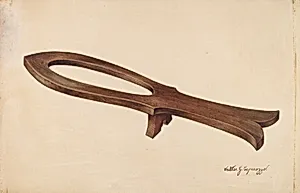
Bootjack
c. 1938
Medium
watercolor and graphite on paperboard
Dimensions
overall: 22.7 x 35.5 cm (8 15/16 x 14 in.) Original IAD Object: 24" long; 9" wide
Classification
Index of American Design
Department
CG-W
Museum
National Gallery of Art, Washington, D.C.
Credit
Index of American Design
Accession Number
1943.8.2028
Rights
Public Domain
Art Historical Context
**Bootjack**, created around 1938 by artist Walter. Capuozzo, captures the humble yet ingenious form of a traditional American bootjack—a wooden tool designed to grip a boot heel and ease removal, essential for frontier farmers and workers. Rendered in watercolor and graphite paperboard (22.7 x 35.5 cm), this precise rendering highlights the object's sturdy, ergonomic shape: 24 inches long and 9 inches wide,oking everyday practicality in early American life. As part of the *Index of American Design* (IAD), a Federal Art Project under the Works Progress Administration (WPA) from 1935 to 1942, Capuozzo's work documents vanishing folk crafts during the Great Depression. The IAD commissioned over 15,000 watercolor renderings by artists nationwide to preserve America's design heritage, blending artistic skill with ethnographic accuracy. Watercolor lent vibrant tones to wood grains and wear patterns, while graphite added fine details, making utilitarian objects like this bootjack symbols of cultural ingenuity. Housed in the National Gallery of Art's collection (Department CG-W), this piece underscores how ordinary tools reflected regional craftsmanship and self-reliance, offering visitors a window into pre-industrial America. It's a testament to the IAD's mission: celebrating the artistry in the everyday.
About the Artist
Walter G. Capuozzo · 1886–1949
**Walter G. Capuozzo** (c. 1886–1949) was an American artist born in Italy whose career intersected with one of the most ambitious documentation projects in U.S. art history. Little is known about his early life or formal training, which remains sparsely documented, but by the late 1930s, Capuozzo had established himself in New York, contributing detailed renderings to the Index of American Design...