Ctrl K
**Wenceslaus Hollar (Václav Hollar, 1607–1677)** was a prolific Bohemian etcher, engraver, and draftsman whose career spanned the turbulent decades of the Thirty Years’ War and the English Civil War. Born in Prague on 13 July 1607, he initially trained for the law before his family’s fortunes collapsed during the 1620 Sack of Prague. Turning to art, he produced his earliest known plates—small copies after Dürer—by 1625–26. In 1627 he moved to Frankfurt, where he apprenticed to the renowned engraver Matthäus Merian, absorbing the precise topographical and illustrative techniques that would define his mature style.
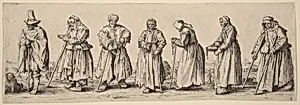
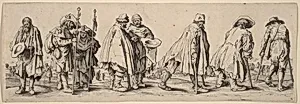
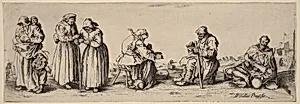
Hollar worked in the Baroque tradition of detailed, observational printmaking, excelling in cityscapes, landscapes, vedute, portraits, and still lifes. He traveled extensively through Germany and the Rhineland before settling in Cologne and later Antwerp. A pivotal moment came in 1636 when he entered the service of Thomas Howard, Earl of Arundel, traveling with the noble collector to Vienna and Prague and then to England in 1637. There he produced some of his most celebrated works, including the monumental *Long View of London from Bankside* (1647). Among his early independent plates are a series of beggar figures etched in 1630 after designs by the French printmaker Jacques Callot; three such etchings—*Six Men and Women Beggars*, *Eight Beggars*, and related compositions—survive in museum collections today and demonstrate Hollar’s skill at translating Callot’s lively, miniature figures into his own crisp, linear idiom.
After Arundel’s death in 1646, Hollar supported himself through book illustration and commercial print publishing, producing thousands of plates on subjects ranging from costume studies and natural history to panoramic city views and maps. He returned to London after the Restoration, documented the Great Fire, and undertook a royal commission to record the fortifications at Tangier. Despite his extraordinary output—some 2,740 etchings—he died in poverty in London on 25 March 1677.
Hollar’s legacy endures in the meticulous visual record he left of seventeenth-century Europe and in the institutions that honor him, including the Václav Hollar Secondary School of Art in Prague. His prints remain prized for their documentary precision and technical virtuosity, bridging the worlds of Callot’s inventive figural scenes and the great topographical traditions of Northern Europe.
All 3 artworks loaded