
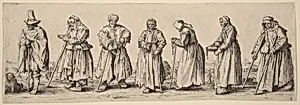
Men and Women Beggars
Medium
etching on laid paper
Dimensions
sheet (trimmed to plate mark): 8.5 × 25.3 cm (3 3/8 × 9 15/16 in.)
Classification
Department
CG-E
Museum
National Gallery of Art, Washington, D.C.
Credit
R.L. Baumfeld Collection
Accession Number
1969.15.6
Rights
Public Domain
Art Historical Context
"Men and Women Begg," an etching on laid paper by Wences Hollar after Jacques Call, dates to 1630 and captures a poignant slice of 17th-century life. Hollar, a skilled Bohemian printmaker known for his meticulous reproductions, faithfully rendered Callot's original design—a French master etcher renowned for his intricate, narrative scenes. This horizontally oriented sheet, measuring just 85 × 25.3 cm, exemplifies the intimate scale of Baroque-era prints, allowing for detailed vignettes within a compact format. The artwork depicts beggars in ragged attire, evoking the widespread poverty and social upheaval of early modern Europe amid the Thirty Years' War. Callot's influential beggar series, including works like *Les Gueux*, highlighted the human cost of conflict and vagrancy, blending empathy with unflinching realism. Hollar's etching preserves this commentary, making elite artistry accessible through affordable prints that circulated widely. Etching's acid-bitten lines enabled Hollar to replicate Callot's virtuoso hatching and cross-hatching, achieving remarkable depth and texture on laid paper. Housed in the National Gallery of Art's R.L. Baumfeld Collection (Department CG-E), this print underscores printmaking's role in documenting societal margins, inviting viewers to reflect on enduring themes of hardship and resilience.
About the Artist
Wenceslaus Hollar after Jacques Callot
**Wenceslaus Hollar (Václav Hollar, 1607–1677)** was a prolific Bohemian etcher, engraver, and draftsman whose career spanned the turbulent decades of the Thirty Years’ War and the English Civil War. Born in Prague on 13 July 1607, he initially trained for the law before his family’s fortunes collapsed during the 1620 Sack of Prague. Turning to art, he produced his earliest known plates—small copi...