Ctrl K
1839–1917
**William Frend De Morgan (1839–1917)** was an English potter, tile designer, and novelist whose inventive ceramics became a hallmark of the Arts and Crafts movement. Born in London to the mathematician Augustus De Morgan and his wife Sophia, he received early support for his artistic ambitions. He attended University College School and briefly studied at the Royal Academy schools before growing disillusioned with academic traditions.
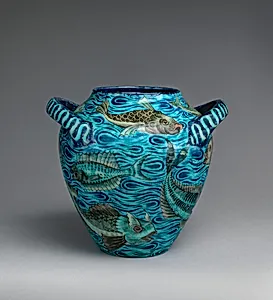
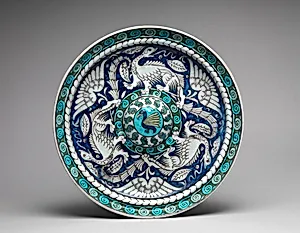
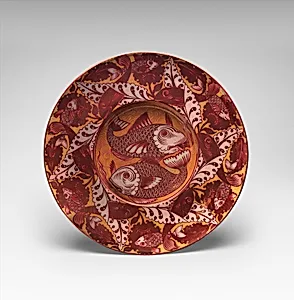
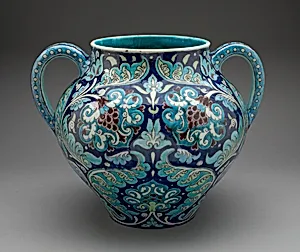
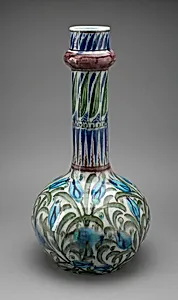
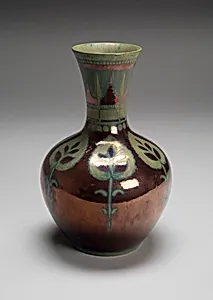
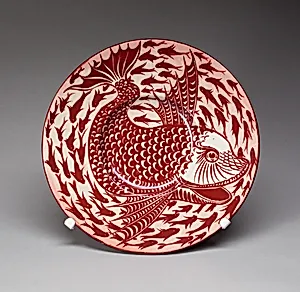
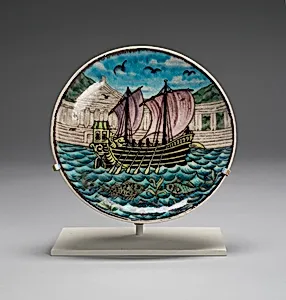
A lifelong friend of William Morris, De Morgan designed tiles, stained glass, and furniture for Morris & Co. between 1863 and 1872. This connection immersed him in the Pre-Raphaelite circle and the broader Arts and Crafts ethos. By 1872 he had devoted himself fully to ceramics, establishing workshops first in Chelsea and later in Fulham (in partnership with architect Halsey Ricardo from 1888). He experimented extensively with glazes, firing techniques, and lustreware, rediscovering methods inspired by Hispano-Moresque and Italian maiolica traditions. His designs drew heavily from medieval and Islamic sources—particularly 15th- and 16th-century İznik ware—employing a vibrant “Persian” palette of deep blues, turquoises, purples, and yellows. Recurring motifs included galleons, fish, fantastical birds and animals, and intricate geometric patterns that formed larger compositions when tiles were arranged together.
De Morgan’s most productive period unfolded in Chelsea during the 1870s, though financial challenges persisted throughout his career. Notable commissions included elaborate tile panels for P&O ocean liners (1882–1900) and the Tsar’s yacht *Livadia* (1880). Many works were executed on commercial blanks or his own high-quality biscuit tiles, often decorated by skilled painters such as the Passenger brothers. In 1907 he abandoned pottery for writing, achieving greater popular success with novels such as *Joseph Vance* (1906). He married the Pre-Raphaelite painter Evelyn Pickering in 1887; she provided both emotional and financial support.
De Morgan died in London in 1917. His legacy endures through major museum collections, including the Victoria and Albert Museum and Birmingham Museum and Art Gallery, as well as preserved installations in Arts and Crafts houses such as Wightwick Manor and Standen. His technical innovations and fusion of Eastern and Western decorative traditions continue to be celebrated for their beauty and craftsmanship.