
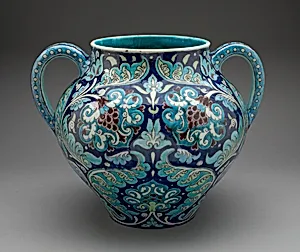
Vase
c. 1885
Medium
Tin-glazed earthenware
Dimensions
28.9 × 37.2 × 31.5 cm (11 3/8 × 14 5/8 × 12 3/8 in.)
Classification
vase
Department
Applied Arts of Europe
Museum
Art Institute of Chicago
Accession Number
63523
Rights
Public Domain
Art Historical Context
This striking vase, created around 1885 by William De Morgan, exemplifies the innovative spirit of the British Arts and Crafts movement. De Morgan, a ceramicist of his time, drew inspiration from historic Islamic and Renaissance pottery traditions while embracing handcrafted techniques in an era of growing industrialization. The piece’s substantial scale—nearly a foot tall and wide—suggests it was designed as a statement object for a refined domestic interior. Crafted in tin-glazed earthenware, the vase highlights a technique prized for its smooth white surface, which allowed artists to apply brilliant colors and intricate patterns before firing. This medium, historically linked to European maiolica and delftware, enabled De Morgan to achieve rich, luminous effects that evoke both medieval and Middle Eastern aesthetics. Now part of the Art Institute of Chicago’s Applied Arts of Europe collection, the work invites viewers to appreciate the careful balance of form, color, and craftsmanship that defined late-19th-century decorative arts.
About the Artist
William De Morgan · 1839–1917
**William Frend De Morgan (1839–1917)** was an English potter, tile designer, and novelist whose inventive ceramics became a hallmark of the Arts and Crafts movement. Born in London to the mathematician Augustus De Morgan and his wife Sophia, he received early support for his artistic ambitions. He attended University College School and briefly studied at the Royal Academy schools before growing d...