Ctrl K
1833–1905
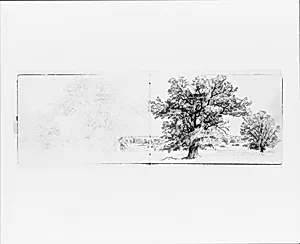
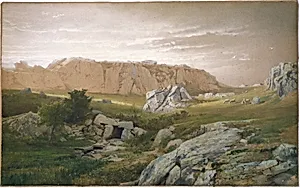
William Trost Richards (1833–1905) was a prominent American landscape and marine painter born in Philadelphia, where he attended Central High School before beginning his artistic training. Between 1850 and 1855, he studied part-time under the German-born Hudson River School artist Paul Weber while working as a designer and illustrator of ornamental metalwork. He exhibited his first works at the Pennsylvania Academy of the Fine Arts in 1852 and was elected an Academician there the following year. In 1854, Richards met key Hudson River School figures including John F. Kensett, Frederic E. Church, Samuel Colman, and Jasper F. Cropsey during a trip to New York, forging connections that shaped his early career.
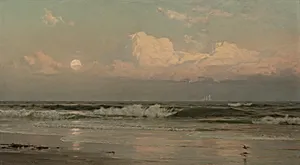
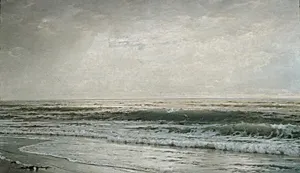
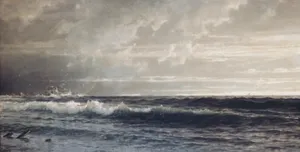
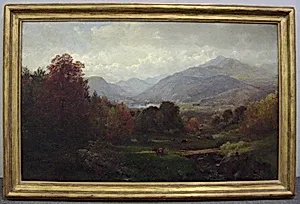
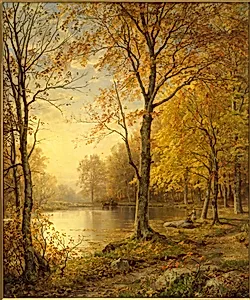
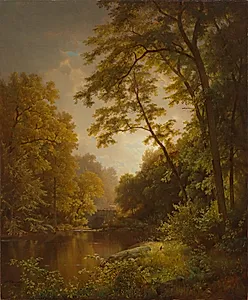
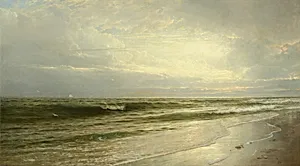
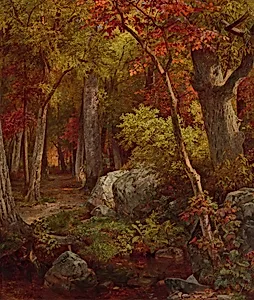
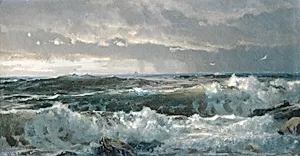
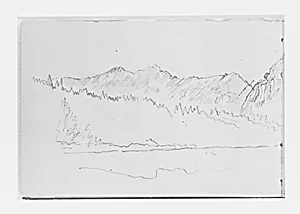
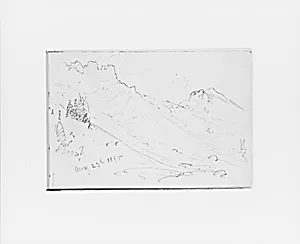
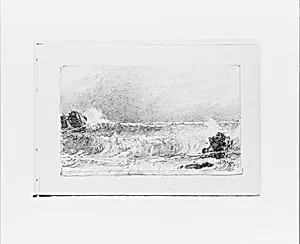
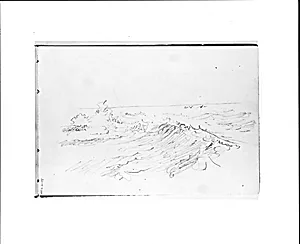
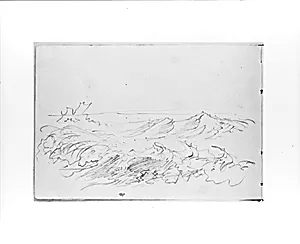
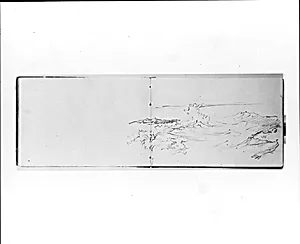
Richards aligned with both the Hudson River School and the American Pre-Raphaelite movement, joining the Association for the Advancement of Truth in Art in 1863 and emphasizing meticulous, truthful renderings of nature over romantic idealization, influenced by John Ruskin. He traveled extensively to Europe in 1855–56 and 1866, studying briefly in Düsseldorf and sketching in the Catskills, Adirondacks, and White Mountains. Elected an honorary member of the National Academy of Design in 1862 and a full Academician in 1871, he joined the American Watercolor Society in 1874. In 1881, he built a home in Jamestown, Rhode Island, later moving to Newport, where he focused on luminous marine watercolors capturing crashing waves and coastal rhythms. He married Anna Matlack Richards; their son Theodore William Richards became a Nobel Prize-winning chemist, and daughter Anna Richards Brewster pursued painting.
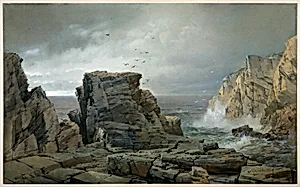
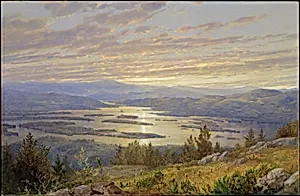
Among his major works are the hyper-realistic White Mountains watercolors like *From the Flume House, Franconia, New Hampshire* (1872) and *Mount Chocorua and Lake* (1873) at the Metropolitan Museum of Art, the dramatic *The League Long Breakers Thundering on the Reef* (1887) at the Brooklyn Museum, and *February* (1887), a stark winter scene near Coatesville, Pennsylvania, at the Pennsylvania Academy. Richards exhibited prolifically at the National Academy (1861–1899) and Brooklyn Art Association (1863–1885), achieving financial success during his lifetime.
Richards's legacy endures in major institutions like the National Gallery of Art, Smithsonian American Art Museum, and Philadelphia Museum of Art, where his precise seascapes and landscapes celebrate nature's raw detail and atmospheric grandeur, bridging Hudson River luminism with Pre-Raphaelite fidelity. He died of heart disease in Newport at age 71, leaving a profound influence on American watercolor traditions.